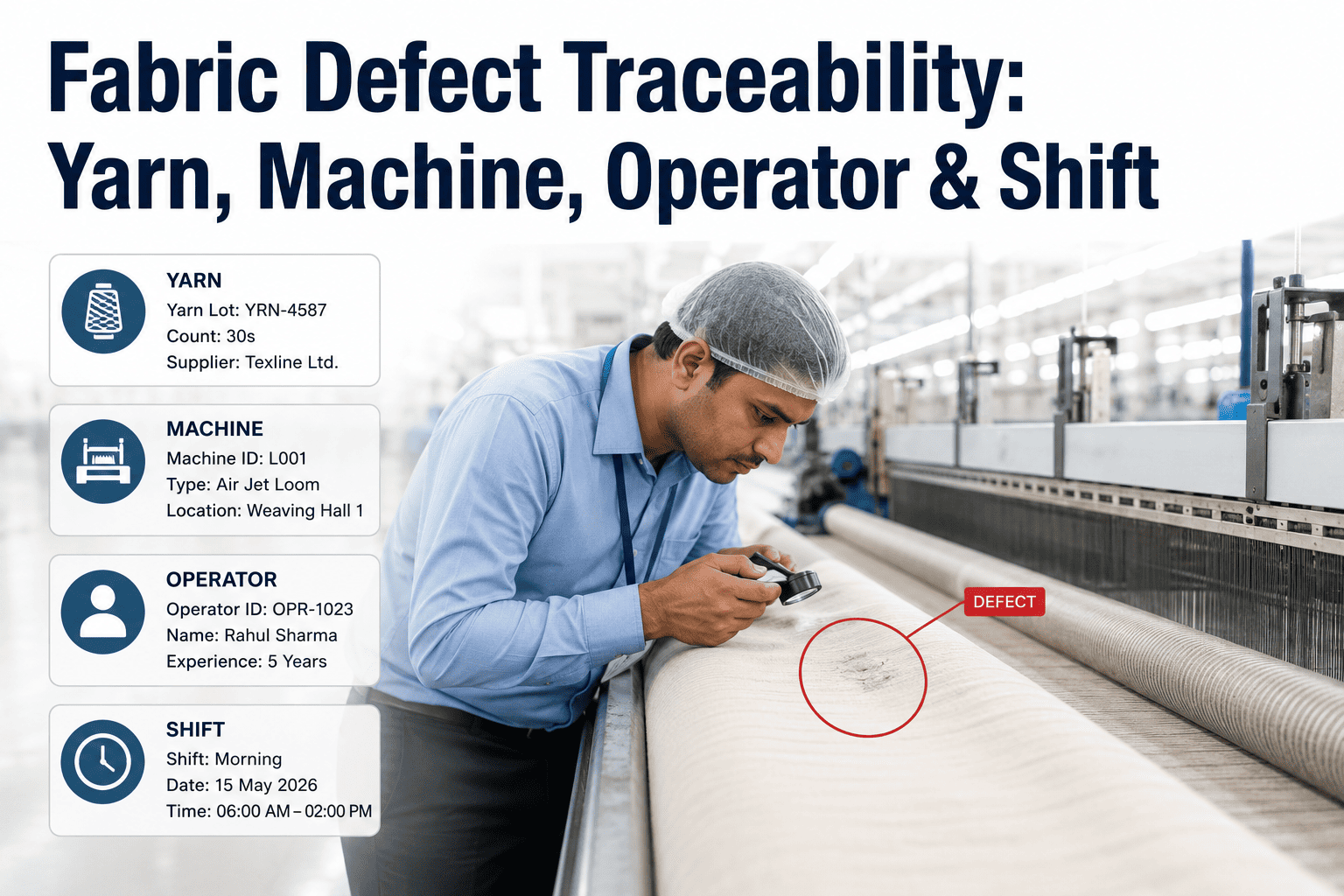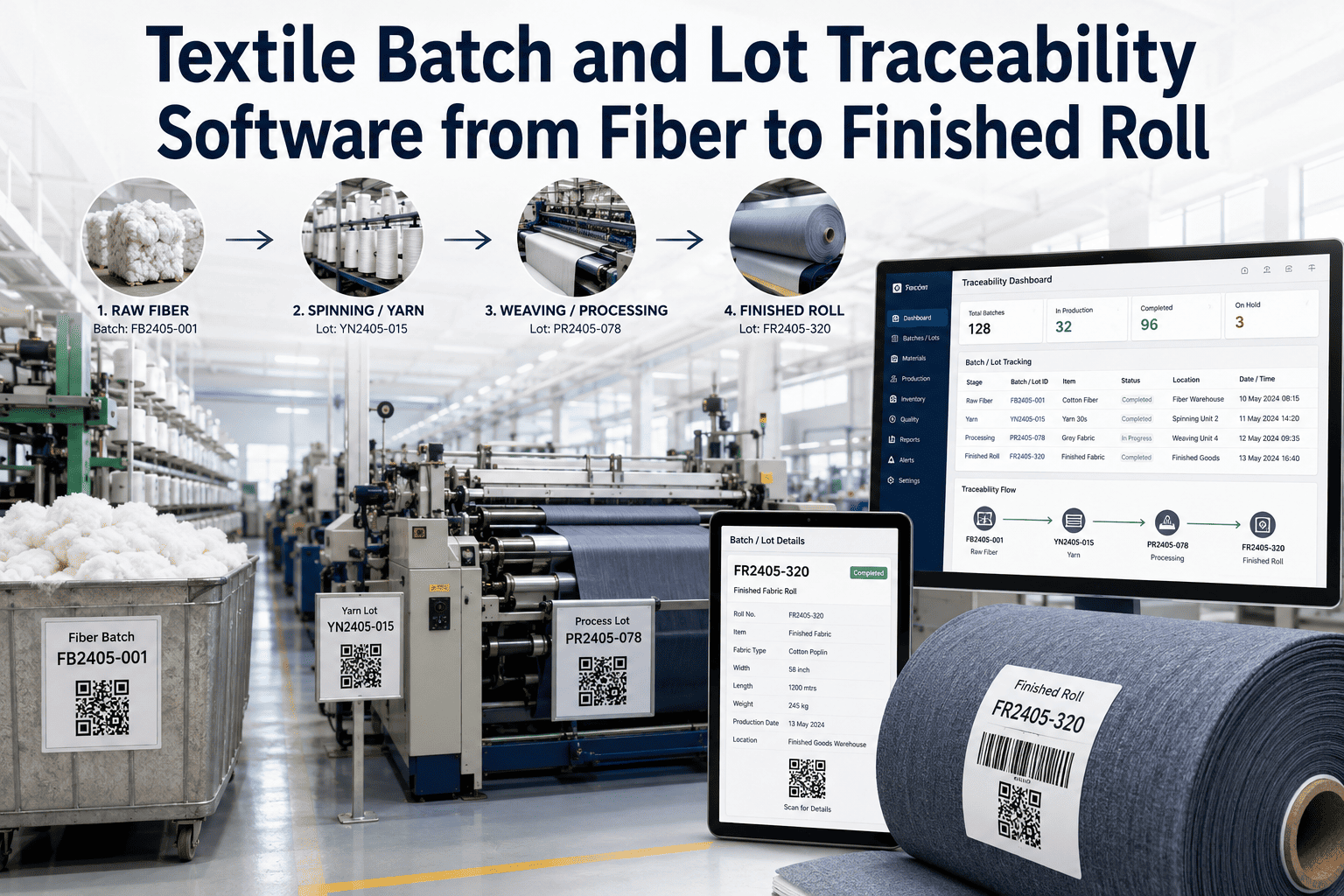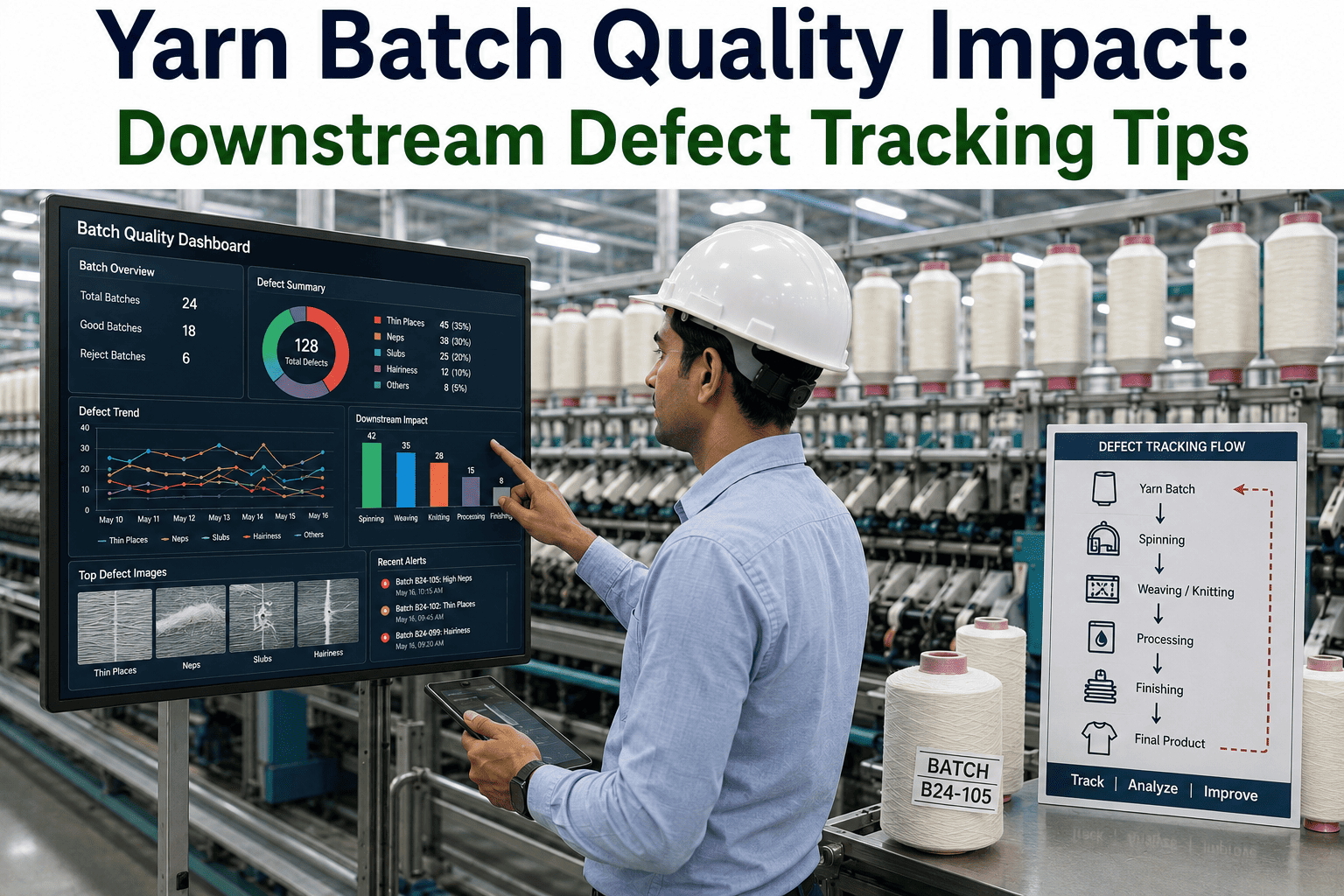
A lab testing yarn evenness samples less than 0.01% of total production — one 100-meter bobbin pulled every few hours from a spinning frame running thousands of kilograms per shift. Everything in between those samples is invisible until it shows up, days or weeks later, as a streak, a bar, or a cloudy patch in finished fabric that a quality team then has to trace backward through weaving, through dyeing, through years of loosely connected paper logs, to figure out which yarn lot actually caused it. iFactory's batch traceability system links every roll of finished fabric back to its exact yarn lot automatically, so that backward trace takes minutes instead of days — and so the pattern connecting a specific supplier's yarn to a specific downstream defect becomes visible before the tenth repeat, not after it. This gap between when a quality problem originates and when it's actually discovered is the central challenge in textile defect traceability. Yarn quality is set at the spinning mill, sometimes weeks before that yarn ever reaches a weaving or knitting floor, and the fabric defect it eventually causes might not surface until final inspection or, worse, until a customer complaint arrives months later. Every stage in between is an opportunity for the connection between cause and effect to get lost — unless the lot identity travels with the material at every handoff.
The Defect Showed Up in Finished Fabric. The Cause Was Sitting in a Yarn Lot Three Steps Back.
Most fabric defects don't originate in weaving or dyeing at all — they're inherited from yarn quality that was already out of spec before the fabric process ever touched it. Without lot-level traceability, that inheritance stays invisible.
The Yarn Parameters That Actually Predict Fabric Defects
Not every yarn quality measurement carries equal weight downstream. A handful of parameters — evenness, imperfections, and hairiness — drive the overwhelming majority of visible fabric defects, and each has a well-documented, specific relationship to how that defect actually appears on finished cloth. Understanding which parameter maps to which defect type is what turns a lab report into an actionable early-warning signal instead of a filed document nobody references again.
This mapping matters because it lets a quality team prioritize limited testing and monitoring resources toward the parameters most likely to explain a given complaint. A customer reporting streaking or a cloudy appearance points a quality investigation directly at evenness data first, rather than spending time ruling out hairiness or tensile strength, which are far less likely to produce that particular visual signature. Knowing the parameter-to-defect map in advance shortens root-cause investigation time considerably, because it tells you where to look first instead of checking every measurement exhaustively.
CVm% (Coefficient of Variation)
The single most important predictor of fabric appearance quality. Yarn with high CVm produces visible streaks, bars, and a cloudy appearance in the finished fabric — the yarn's thickness variation shows up directly as a visual defect once it's woven or knitted into cloth.
Thick Places, Thin Places, Neps
Localized defects rather than a continuous variation — a nep is a small entangled knot of fiber that shows up as a visible speck once fabric is dyed, while thick and thin places create isolated irregularities in fabric density and appearance at specific points along the roll.
Hairiness
Measures fiber protrusion from the yarn's main body. High hairiness increases fuzziness and pilling tendency in the finished fabric and generates excess lint during weaving, which itself becomes a downstream source of process disruption on the loom.
Tensile Strength & Elongation
Determines whether yarn survives the mechanical stress of weaving or knitting without breaking. Low or inconsistent strength doesn't always show as a visible fabric defect — it shows as production downtime from warp breaks and weft stops that get logged as a machine problem rather than a yarn quality issue.
USTER Statistics — The Benchmark That Makes "In Spec" Actually Mean Something
A yarn quality report full of raw numbers is only useful with something to compare it against. USTER Statistics has served as the global reference for decades, expressing every yarn quality parameter as a percentile against worldwide production data — a CVm rated at the 25th percentile means 75% of tested yarn globally performs worse on that measure, giving mills and their customers a shared, objective language instead of each party arguing from their own internal standard.
The percentile framing does something subtler than just providing a number to compare against — it converts an isolated measurement into a competitive and commercial signal. A mill buying yarn rated in the bottom half of the global distribution is, in effect, accepting a materially higher defect risk than a mill sourcing top-quartile yarn, even if both lots technically pass a loosely written internal specification. Contracts and purchasing decisions that reference USTER percentile bands explicitly, rather than vague internal pass/fail thresholds, give both the buyer and the supplier a much clearer shared understanding of what's actually being agreed to.
What makes this benchmark particularly relevant for traceability work is that the standard itself has tightened meaningfully over time. A yarn that would have rated as solidly mid-pack decades ago would rate as clearly below-average against today's percentile bands — quality expectations have risen steadily as spinning technology and measurement precision have both improved. A supplier contract written against an outdated internal spec, rather than the current USTER percentile bands, can quietly permit yarn that's actually below today's acceptable threshold without anyone noticing until the fabric defects start accumulating.
| USTER Percentile | What It Means | Typical Use |
|---|---|---|
| 5% | Top 5% of global production — best-in-class quality | Premium fabric, technical textiles |
| 25% | Better than 75% of global production | Standard for most quality-conscious mills |
| 50% | Global average — median performance | Common contract baseline, commodity fabric |
| Below 50% | Below global average — elevated defect risk | Requires justification or price adjustment |
A Yarn Lot That Fails Its Own Spec Shouldn't Have to Wait for a Fabric Defect to Get Noticed
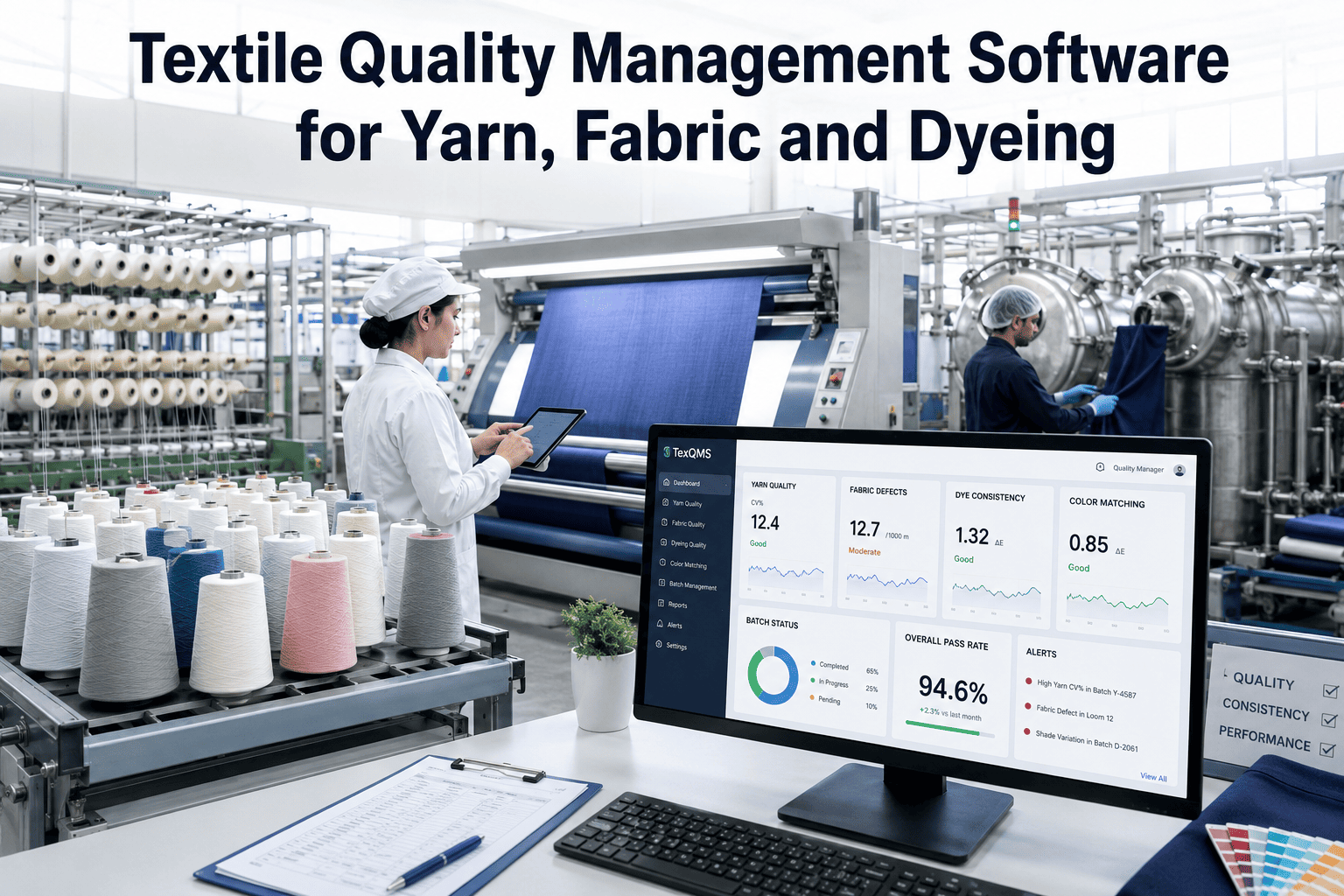
iFactory links incoming yarn test data to every downstream roll automatically, so a lot trending toward its CVm limit gets flagged before it's woven into fabric — not after a customer complaint traces it back.
Building a Batch Correlation System — From Lot Number to Root Cause
Traceability only delivers its full value when the connection between yarn lot and finished defect is genuinely queryable, not just recorded. A mill that assigns lot numbers at receiving and logs defects at inspection has the raw ingredients for traceability, but if those two records live in separate systems that were never designed to be joined, the actual trace-back still requires a person manually cross-referencing spreadsheets — which is slow enough that most mills only do it for serious, high-cost defects, letting smaller recurring issues go uninvestigated indefinitely.
The distinction between "recorded" and "queryable" is where most traceability initiatives quietly stall. It's entirely possible to have complete data — every lot number, every test result, every defect log — and still be functionally unable to trace a specific fabric roll back to its yarn source in any reasonable time, simply because the data lives in formats and systems that were never connected to each other. A paper log of receiving lots and a separate digital defect-tracking spreadsheet are both "recorded," but neither is queryable against the other without manual effort that most mills don't have the staff time to perform routinely.
Capture supplier lot identity at receiving, not later
Every incoming yarn shipment needs its supplier lot number recorded and linked to an internal receiving lot the moment it arrives — a gap here breaks the entire trace-back chain before it starts.
Attach yarn test data to the lot record, not a separate file
CVm, imperfections, and hairiness results need to live on the same lot record that production consumes from — a test report filed separately from the lot it describes is effectively lost data for correlation purposes.
Track lot consumption through every production stage
Each greige roll, dye batch, and finished roll needs a recorded link back to the yarn lots that fed it — this is the chain that makes a backward trace from finished defect to source lot possible in the first place.
Log every defect against the full chain, not just the final stage
A defect record that only notes "fabric roll #4471, cloudy shade" is far less useful than one that automatically resolves to the specific yarn lot, dye batch, and machine involved at the moment the defect is logged.
Aggregate defects by supplier and lot over time
A single defect traced to a supplier is a data point; the same supplier appearing repeatedly across independent defect investigations is a pattern worth a structured conversation, not just another closed ticket.
Turning Traceability Data Into Supplier Accountability
The commercial value of yarn-to-defect traceability goes beyond faster root-cause investigation on any single incident — it changes the nature of the conversation with suppliers entirely. Without traceability data, a quality dispute is inherently subjective: the mill believes the yarn caused the problem, the supplier has no reason to agree, and the conversation stalls on competing narratives. With a documented chain connecting a specific lot number, specific test data, and a specific downstream defect, the conversation shifts from opinion to evidence.
This shift has a practical effect on how quickly disputes actually resolve. A supplier presented with vague feedback — "we've had some quality issues with your yarn lately" — has little to act on and every reason to be defensive, since the claim can't be independently verified or narrowed down. A supplier presented with a specific lot number, the exact test data that lot produced, and the specific downstream defect it's linked to has something concrete to investigate on their own production floor, which tends to produce faster and more genuine corrective action than a general complaint ever does.
This evidentiary shift matters most over time, not on any single incident. A single traced defect might reasonably be attributed to a one-off process variation on the supplier's end. The same supplier's yarn appearing at the root of defect investigations three times in a quarter is a different conversation entirely — one a structured supplier scorecard makes visible in aggregate, rather than three isolated incidents that never get connected because they were investigated by different people, weeks apart, without a shared record to compare them against.
Supplier scorecards built on this kind of aggregated traceability data also change the tenor of sourcing decisions over time. Instead of allocating purchase volume based on price and delivery performance alone, a mill with genuine defect-correlation data can factor in a supplier's actual quality track record — measured not by self-reported certificates, but by how often that supplier's material has been the documented root cause of a downstream problem. That's a meaningfully different, and more defensible, basis for a sourcing decision than reputation or price alone.
Common Mistakes That Undermine Yarn-to-Fabric Traceability
The mills that get real value from traceability aren't the ones with the most sophisticated software — they're the ones that treat every defect, not just the expensive ones, as worth a full trace-back. A five-minute lookup that resolves a cloudy-shade complaint to a specific supplier's spinning frame is worth almost nothing on its own. The same lookup repeated consistently, across every defect, for a year, is what turns into a supplier scorecard that actually changes behavior.
Frequently Asked Questions
How far back can a fabric defect realistically be traced to a specific yarn lot?
With a properly maintained lot-tracking chain — yarn lot to greige roll to dye batch to finished roll — a trace-back is technically possible for as long as the underlying records are retained, which for most mills means months to a few years depending on data retention policy. The practical limit isn't usually the technology; it's whether every link in that chain was actually recorded at the time, since a single missing linkage anywhere in the sequence breaks the trace at that point.
Retroactively reconstructing a broken chain after the fact is difficult to impossible, which is why capturing the linkage at each production stage as it happens matters more than having a sophisticated query tool after the fact. Book a demo to see how iFactory captures lot linkage automatically at each production stage rather than relying on manual entry.
What yarn quality parameters should we prioritize tracking if we can't monitor everything?
CVm% evenness is the single highest-value parameter to prioritize, since it's the most direct predictor of visible fabric appearance defects like streaking and barre — problems that are highly visible to customers and expensive to rework. Imperfections (thick places, thin places, and neps) are the next tier, since they produce visible specks and localized irregularities that are almost as damaging to perceived quality.
Hairiness and tensile strength matter more depending on your specific fabric type and end use — hairiness affects pilling-prone knits more than smooth wovens, while strength matters most on high-tension weaving applications prone to warp breaks. Book a demo to review which parameters correlate most strongly with your specific historical defect patterns.
How do we have a productive conversation with a supplier about a traced quality issue without damaging the relationship?
Traceability data works best as the foundation for a collaborative conversation, not an accusation — presenting specific lot numbers, test data, and the documented downstream defect gives the supplier something concrete to investigate on their end rather than a vague complaint they can't act on. Framing the conversation around "here's what we found, help us understand what happened" tends to produce more useful supplier engagement than framing it as a dispute to be won.
For suppliers with a pattern of recurring issues, aggregated scorecard data — several traced incidents over a quarter rather than one isolated complaint — carries more weight and is harder to dismiss as a one-off. iFactory's support team can help structure a supplier scorecard that presents this data clearly for those conversations.
Is it worth investigating every minor defect back to its yarn lot, or only significant ones?
Investigating only high-cost defects is a common practice, but it systematically misses the pattern-level insight that comes from aggregating many smaller incidents. A minor defect that costs little to rework individually can still be part of a recurring pattern from the same yarn lot or supplier that, in aggregate, represents a meaningful and preventable cost once you can see it across multiple occurrences rather than as isolated tickets.
The practical answer depends on how automated the trace-back process is — if resolving a defect to its source lot takes five minutes rather than an afternoon of manual cross-referencing, investigating every defect becomes realistic rather than a resource-intensive exception. Book a demo to see how fast an automated trace-back actually runs on real production data.
Can traceability data help before a defect even happens, not just after?
Yes, and this is where traceability shifts from a reactive investigation tool to a proactive quality control layer. If incoming yarn test data is linked into the same system that tracks historical defect correlation, a lot trending toward its CVm or imperfection limit can be flagged at receiving, before it's ever woven into fabric — especially if that supplier or lot range has a documented history of contributing to defects previously.
This proactive use requires the same underlying data foundation as reactive trace-back; the difference is simply querying it at receiving instead of only after a complaint arrives. Book a demo to see how iFactory flags at-risk incoming lots before they enter production.
Stop Investigating Defects From Scratch Every Time
iFactory links every yarn lot, greige roll, dye batch, and finished roll into one queryable chain — so a fabric defect resolves back to its source lot within minutes, and recurring supplier patterns become visible before the fifth repeat, not after.