Yarn dyed before weaving or knitting behaves nothing like yarn dyed in fabric form, because the dye must penetrate through a densely wound package, hank, or cone rather than a flat, open surface, and any inconsistency in liquor flow through that wound mass shows up as visible streaks, listing, or center-to-outside shade variation once the yarn is woven into cloth. Choosing the wrong dyeing method for a given yarn count and package density is one of the most common and costly mistakes in yarn dye houses. Book a demo to see how iFactory tracks flow rate and levelness across every yarn dyeing method.
Yarn Dyeing Intelligence
Package, Hank, Cheese, or Cone: The Method You Choose Decides the Shade You Get
Comparing package, hank, cheese, and cone dyeing methods - flow rate, levelness risk, and the process controls that keep yarn shade consistent from center to outside.
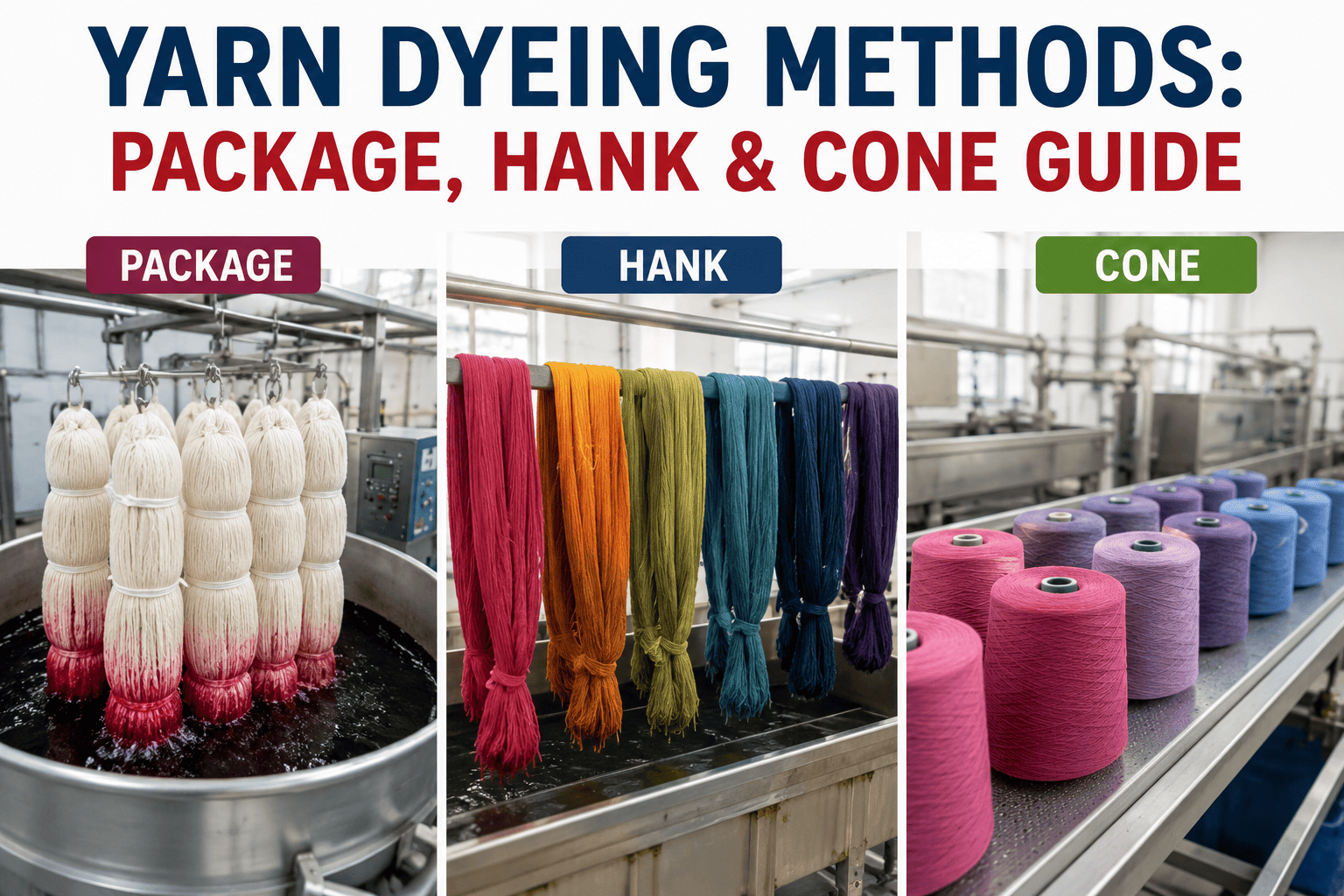
Package
Cone/cheese on perforated spindle
Hank
Loose coil, open bath immersion
Cheese
Cylindrical wound, parallel winding
Cone
Tapered wound, precision packages
Four Yarn Dyeing Methods and What Each One Is Built For
Every yarn dyeing method solves the same basic problem, forcing dye liquor through a mass of wound or coiled yarn, but each does it with a different mechanism, and that mechanism determines which yarn types, fiber blends, and shade requirements it handles best.
01
Package Dyeing
Yarn is wound onto perforated spindles and loaded into a pressure vessel where dye liquor is pumped radially in and out through the package under controlled pressure and flow reversal. This is the dominant method for cotton and synthetic yarns in bulk production due to high capacity and strong process repeatability.
02
Hank Dyeing
Yarn is wound into loose, open coils and hung or looped in an open dye bath with gentle mechanical agitation. This method gives the softest handle and best bulk retention, making it the standard choice for hand-knitting yarns and wool where package pressure would felt or flatten the fiber.
03
Cheese Dyeing
A sub-category of package dyeing where yarn is wound in a straight cylindrical form rather than tapered, giving uniform density from top to bottom of the package and more predictable radial liquor flow, commonly used for cotton hosiery and knitting yarns.
04
Cone Dyeing
Yarn is wound onto a tapered cone shape optimized for downstream unwinding speed in weaving or knitting, requiring careful winding density control since the tapered geometry naturally creates uneven liquor resistance from the narrow to wide end of the package.
Why Center-to-Outside Shade Variation Happens
The single most common defect in package and cone dyeing is a visible shade difference between the yarn wound closest to the spindle core and the yarn wound on the outer layers, and it happens because dye liquor naturally takes the path of least resistance through the package rather than distributing evenly across every layer.
Core LayerHighest flow exposure, risk of over-dyeing
Mid LayerBalanced flow, target shade zone
Outer LayerLowest flow exposure, risk of under-dyeing
Controllable Causes of Layer Variation
Winding density too tight, restricting liquor penetration to outer layers
Flow rate too low for the package size and yarn count being processed
Insufficient flow reversal cycles between inside-out and outside-in pumping
Pump pressure drift during the dyeing cycle changing effective flow rate
Is Your Outer Layer Shade Quietly Drifting From the Core?
iFactory tracks flow rate, pressure, and reversal cycle timing on every package dyeing machine, catching the conditions that cause layer variation before the yarn leaves the vessel.
Method Selection Matrix: Matching Yarn Type to Dyeing Method
Choosing the right dyeing method for a given yarn count, fiber type, and end use significantly reduces the risk of levelness defects before the batch even starts. The matrix below reflects the method most dye houses reach for based on yarn characteristics and downstream use.
| Yarn Type / Use Case |
Package |
Hank |
Cheese |
Cone |
| Cotton knitting yarn, bulk | Best | OK | Best | OK |
| Wool, hand-knitting | Poor | Best | Poor | Poor |
| Synthetic filament yarn | Best | Poor | OK | Best |
| Weaving warp yarn, high speed unwind | OK | Poor | OK | Best |
| Delicate or high-bulk fiber | Poor | Best | Poor | Poor |
Flow Rate and Pressure: The Variables That Actually Control Levelness
Package and cheese dyeing levelness comes down almost entirely to how consistently liquor flows through the wound yarn mass, and that consistency depends on three interacting variables that need to move together rather than being set once at the start of the cycle.
Flow Rate
Must scale with package density and diameter. Undersized flow for a large package leaves the outer layers starved of fresh liquor throughout the cycle.
Flow Reversal Frequency
Regular inside-out and outside-in cycling equalizes exposure across all layers. Infrequent reversal concentrates dye near whichever direction ran longest.
Winding Density
Package density set at winding, before dyeing even starts, determines how much resistance liquor meets. Overly tight winding cannot be corrected by process settings alone.
From Manual Spot-Checks to Monitored Yarn Dyeing: A 4-Step Path
Most yarn dye houses already have the right machine and the right recipe on paper. The gap that causes layer variation and rejected lots is almost always in how consistently flow rate, pressure, and reversal timing are held to that recipe across the full cycle. Here is the path to closing that gap.
Step 1
Baseline Flow and Pressure by Package Type
Record actual flow rate and pressure readings across a full cycle for each package size and yarn count your dye house runs regularly.
Step 2
Install Continuous Flow and Pressure Sensors
Move beyond periodic gauge readings to continuous logging that captures flow drift and pressure drops throughout the entire dyeing cycle.
Step 3
Set Layer Variation Risk Alerts
Configure alerts tied to flow rate thresholds specific to each package density, flagging cycles at elevated risk of center-to-outside variation before unloading.
Step 4
Correlate With Lab Shade Approval Data
Match flagged cycles against lab shade check results to refine thresholds until flow monitoring reliably predicts which cycles will pass or fail approval.
Frequently Asked Questions
What is the main difference between package dyeing and hank dyeing?
Package dyeing forces liquor through a tightly wound cone or cheese under pressure, which gives high production capacity and strong process repeatability but requires precise flow and pressure control to avoid center-to-outside shade variation. Hank dyeing uses loosely wound, open coils immersed in an open bath with gentle mechanical movement rather than forced liquor flow, which produces a softer yarn handle and better bulk retention since there is no pressure compacting the fiber, but it has lower throughput and is generally reserved for wool and specialty yarns where handle matters more than volume.
Book a demo to see flow monitoring across package dyeing lines.
Why does yarn dyed in package form sometimes show a lighter shade on the outer layers?
Liquor pumped through a wound package naturally takes the path of least resistance, and the outer layers of a densely wound cone or cheese offer more resistance to flow than layers closer to the perforated spindle core, especially if winding density is too tight or flow rate is undersized for the package diameter. Without regular flow reversal between inside-out and outside-in pumping, dye liquor concentrates its exposure on whichever side ran longest, leaving the far side under-dyed and visibly lighter once the package is unwound.
Which yarn dyeing method is best for wool and hand-knitting yarns?
Hank dyeing is the standard method for wool and hand-knitting yarns because the loose, open coil configuration and gentle bath agitation avoid the pressure and compaction that package dyeing applies, which can felt wool fiber or flatten the loft that gives hand-knitting yarn its characteristic bulk and softness. Package or cheese dyeing under pressure works well for cotton and synthetic yarns that tolerate compaction, but applying that same pressure to wool typically produces a harder handle and reduced loft that is unacceptable for premium hand-knitting products.
Contact our support team to review the right method for your yarn portfolio.
How does winding density affect yarn dyeing quality?
Winding density, set during the winding process before the yarn ever reaches the dye machine, determines how much resistance dye liquor encounters as it flows radially through the package. Yarn wound too tightly creates a dense mass that even a well-calibrated flow rate and pressure setting cannot fully penetrate evenly, causing under-dyeing in the tightest sections regardless of how the dyeing cycle itself is run. Because winding density cannot be corrected once dyeing begins, it needs to be controlled and validated as a upstream quality checkpoint, not treated as a dyeing-stage problem.
Why is cone dyeing more prone to shade variation than straight cheese dyeing?
A cone package has a tapered shape, wider at the base and narrower at the tip, which means the effective liquor path length and resistance is not uniform across the full package the way it is in a straight cylindrical cheese package. This geometric difference creates naturally uneven flow distribution from the narrow to wide end of the cone, requiring tighter control of winding density and flow reversal timing to compensate for the shape-driven variation that cheese packages do not experience to the same degree.
Every Layer of the Package Should Match the Same Shade
iFactory gives your yarn dye house continuous visibility into flow rate, pressure, and reversal cycling across every package, hank, cheese, and cone dyeing run.