How AI Is Transforming Food & Beverage Autonomous RCA in 2026
By lamine yamal on May 25, 2026
Food & beverage operators experience root-cause investigation in a specific frustrating pattern — a scrap event fires, the line stops or rejects pile up, the operator is asked to investigate while production pressure mounts, the manual investigation drags on 30–90 minutes, and by the time the root cause is documented, the immediate situation has already cost throughput, ingredient waste, and quality variance. The investigation conclusion frequently lands somewhere between "probably the dough mixer" and "we'll need to run more samples" — useful for the deviation report, less useful for actually preventing the next occurrence. Autonomous Root Cause Analysis changes this pattern fundamentally. AI agents maintain a continuous causal hypothesis about plant operations, running multivariate correlations across equipment state, recipe parameters, ingredient lot history, environmental conditions, and operator actions. When an anomaly fires, the root cause is already pre-computed — the operator sees an evidence-backed explanation in 3–5 minutes rather than building one from scratch in 30–60 minutes. Combined with Predictive Scrap Prevention that anticipates problems 4–24 hours ahead, the RCA + prediction stack changes the operator's daily relationship to scrap events. iFactory AI delivers this on a pre-configured NVIDIA appliance running on-premise inside the plant — replacing SAP MII, SAP xMII, and SAP DMC with an AI-native platform purpose-built for the realities of F&B operations, live in 6–12 weeks. This page is the F&B operator's guide to why cloud-only MES architectures fail at the autonomous RCA and predictive scrap requirements, what the integrated AI stack actually delivers, and how on-prem deployment makes it work.
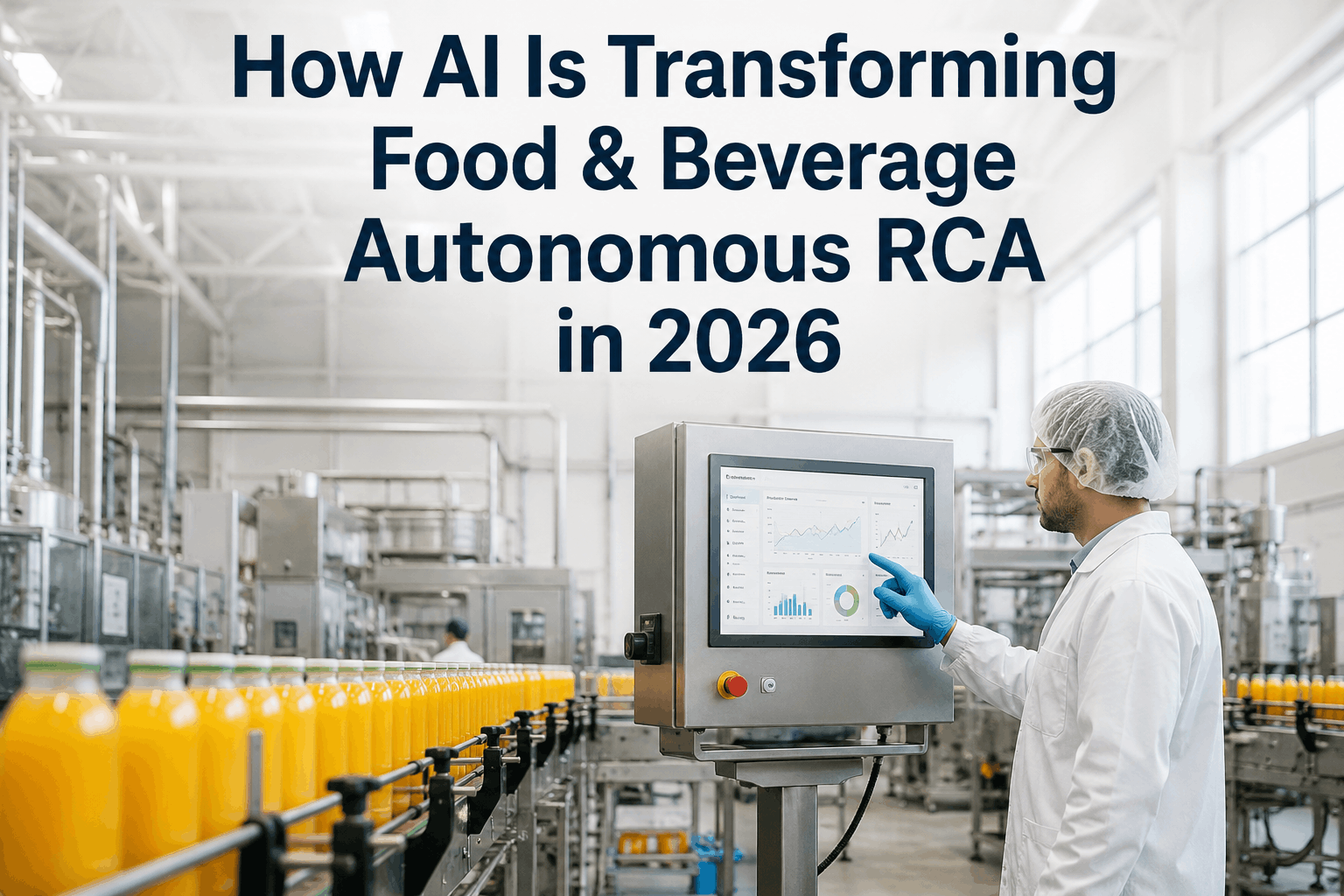
How AI Is Transforming Food & Beverage Autonomous RCA in 2026
The F&B operator's guide to autonomous root-cause analytics and predictive scrap prevention — RCA in 3–5 minutes instead of 30–60 · scrap events anticipated 4–24 hours ahead · integrated stack running on-premise inside your plant. The top SAP MII alternative for F&B operations. Pre-configured NVIDIA AI server, software pre-loaded, 12-week delivery.
Autonomous RCA versus 30–60 minute manual investigation
−65–80%
Scrap event reduction within 12 months of deployment
4–24 hr
Predictive scrap warning window before event materializes
On-prem
No cloud lock-in · works during WAN outages · 12-week delivery
Why Cloud-Only MES Fails for F&B Operators Specifically
Cloud-only MES architectures (SAP DMC and similar) work fine for batch-level reporting and cross-site analytics — but they fail at the operational requirements F&B operators face minute-by-minute on the line. The six failure modes below come from real operator experience, not marketing critique. Each one matters for whether RCA can actually run autonomously and whether predictive scrap prevention can actually work at production speed.
SIX CLOUD-ONLY MES FAILURE MODES · OPERATOR PERSPECTIVE
Why F&B operations specifically require on-prem AI for autonomous RCA and predictive scrap prevention
1
Latency Kills Real-Time RCA
Cloud round-trip latency of 200–800ms makes real-time autonomous RCA impossible. AI inference needs sub-50ms response — only achievable with on-prem edge compute.
Impact — RCA arrives after scrap event already fired
2
WAN Outages Stop Production
F&B plants experience 8–24 WAN outage incidents annually. Cloud-only MES means RCA, predictions, and SPC all go offline. On-prem keeps the AI working when WAN drops.
Impact — Operator loses AI assist exactly when needed
3
Recipe Data Sovereignty
F&B recipes are core IP. Sending recipe data and operational signatures to cloud creates regulatory and competitive exposure. On-prem keeps recipes inside the plant.
Impact — IP risk · supplier negotiation exposure
4
Sanitation Window Cloud Delays
F&B operations sanitize 1–4 times per shift. Cloud re-authentication, recipe loading, and validation handshakes can add 5–15 minutes per cycle. On-prem is instant.
Impact — 30–60 min lost daily per line
5
Audit Evidence Not Locally Accessible
FSMA, HACCP, and customer audit evidence must be retrievable on demand. Cloud-only means dependence on WAN for any audit response. On-prem makes evidence always available.
Impact — Audit response delays · scorecard risk
6
Cloud Lock-In Compounds Risk
Cloud-only MES creates vendor lock-in that compounds over time as operational data, integrations, and validations accumulate. On-prem preserves operational flexibility.
Impact — Switching cost grows exponentially
Each failure mode independently undermines what F&B operators need from autonomous RCA and predictive scrap prevention. Together, they make cloud-only MES architecturally incompatible with the operational pace of modern F&B production. The pre-configured NVIDIA AI server running on-premise inside the plant solves all six simultaneously — and that's why "on-prem AI server, pre-loaded software, 12-week delivery" is the specific architecture iFactory delivers rather than another cloud-only product.
Want a sized assessment of how cloud-only MES failure modes would specifically affect your F&B operation? Schedule the AI Manufacturing Transformation Workshop — iFactory's F&B team will assess your specific exposure to each failure mode and model the on-prem alternative concretely. Sessions available this week.
Autonomous RCA — How It Actually Works on the Line
"Autonomous RCA" sounds like marketing language until you see the technical mechanism. iFactory's Investigation Agent maintains a continuous causal hypothesis about plant operations — tracking equipment state, recipe parameters, ingredient lot history, environmental conditions, operator actions, and quality outcomes in a multivariate causal graph that updates with every new data point. When an anomaly fires, the agent doesn't start investigating — it has been investigating continuously and now surfaces its already-computed conclusion ranked by probability. The workflow below shows what actually happens in those crucial 3–5 minutes.
AUTONOMOUS RCA · WORKFLOW FROM ANOMALY TO OPERATOR DECISION
3–5 minute total versus 30–60 minute manual baseline · operator sees evidence, not blank investigation
The order-of-magnitude time difference doesn't come from making the operator work faster — it comes from making the operator work later in the workflow. The investigation has already happened. The operator's role becomes verification, judgment, and decision-making rather than data gathering and correlation. Operators consistently report this as the most visible daily difference after migration — RCA stops being something that interrupts production work and becomes something that supports it.
Predictive Scrap Prevention + Autonomous RCA — The Integrated Stack
INTEGRATED CAPABILITIES · SCRAP PREVENTION + RCA
How the two AI capabilities work together to prevent scrap before it happens
Predictive Scrap Prevention and Autonomous RCA aren't separate features — they're complementary capabilities operating on the same multivariate causal graph. The integration delivers what neither could deliver alone: scrap events anticipated 4–24 hours ahead with the root cause already identified before the event materializes. Operators get warnings with explanations and recommended actions, not just alerts.
Want to see Predictive Scrap Prevention + Autonomous RCA running on representative F&B scenarios? Schedule the AI Manufacturing Transformation Workshop — sessions include live demonstration of the integrated stack tuned to your specific F&B products. Sessions available this week.
Three Migration Paths from SAP MII for F&B
THREE PATHS · F&B AUTONOMOUS RCA MODERNIZATION
Same starting point — three architectures with different operator experience and scrap economics
PATH 1
Stay on MII / xMII
Extended maintenance, manual RCA paradigm continues. No autonomous RCA, no predictive scrap prevention. Operator workflow unchanged.
Defer · scrap unchanged
PATH 2
SAP DMC (Cloud-Only)
Cloud migration with all six operator failure modes intact. Autonomous RCA latency-bound. Cloud lock-in compounding over time.
$2–5M · 18–30 months
PATH 3 · RECOMMENDED
iFactory AI On-Prem
Autonomous RCA + Predictive Scrap Prevention. On-prem NVIDIA appliance solves all six cloud failure modes. HACCP/FSMA aligned.
$0.6–2.2M · 6–12 weeks
Six F&B Operations Where Autonomous RCA + Scrap Prevention Pay Back Fastest
Bakery & Sweet Goods
Mixing · proofing · baking
Autonomous RCA correlates oven temperature, mixing time, dough rheology, and finished product appearance. Predictive scrap catches dough variance signatures early.
Scrap reduction — 70–80%
Snack Bar & Confectionery
Ingredient mixing · molding · enrobing
Multi-ingredient scrap signatures linked to specific lot characteristics. Pre-computed RCA cuts investigation time. Recipe optimization continuous.
Scrap reduction — 65–75%
Beverage Filling Operations
Carbonated · juice · water · dairy
Filler head correlations, CIP timing optimization, packaging quality. Predictive scrap warning 4–24 hours ahead on high-throughput lines.
Scrap reduction — 60–75%
Dairy Processing
Yogurt · cheese · milk
Multi-step process correlations across pasteurization, fermentation, packaging. Allergen segregation predictive monitoring. Customer audit evidence continuous.
Scrap reduction — 65–80%
Meat & Poultry Processing
Cutting · packaging · cold chain
RCA links cutting yield variance to specific blade conditions, ambient temperature, animal source. Cold chain compliance monitoring continuous.
HACCP, FSMA, SQF, BRC & Allergen Control — Built In
F&B REGULATORY · NATIVE TO IFACTORY
Pre-built workflows for food & beverage regulatory frameworks
HACCP — Hazard Analysis and Critical Control Points
FSMA — Food Safety Modernization Act (FDA)
SQF — Safe Quality Food certification
BRC / GFSI — global food safety standards
Allergen management — segregation and verification
USDA — meat & poultry inspection support
FDA 21 CFR Part 117 — preventive controls
Lot traceability — forward and backward chain
The Compliance Layer assembles HACCP, FSMA, and customer audit evidence continuously as production runs — all stored on-prem, available during WAN outages, and retrievable without cloud round-trip latency. Customer audit prep (Walmart, Target, Costco, major chains) drops from 1–2 weeks of manual preparation to 2–4 hours of review.
Two Real F&B Operator Outcomes
SCENARIO 1 — MULTI-PRODUCT SNACK BAR MANUFACTURER
Snack bar manufacturer with 18 SKUs and chronic scrap from ingredient variability
A mid-size snack bar manufacturer producing 18 SKUs across 4 production lines. Scrap rates averaged 6.8% with ingredient lot variability and process drift driving most events. Manual RCA took 45–75 minutes per incident with conclusions often inconclusive. SAP MII captured the operational data but couldn't pre-compute RCA or predict scrap signatures ahead of time.
6.8% → 1.6%
Scrap rate
$4.2M
Year-one savings
10 wk
Deployment timeline
Approach — iFactory on-premise NVIDIA appliance with Predictive Scrap Prevention + Autonomous RCA across all 4 lines. Investigation Agent trained on 18 months of historical scrap-event data with ingredient lot correlations. RCA time dropped from 45–75 min to 3–5 min per event. Scrap rate dropped from 6.8% to 1.6% in year one. Year-one savings $4.2M against $1.3M total program cost. Customer scorecards moved from yellow to green at two major retail accounts.
Premium confectionery manufacturer with chocolate molding and tempering issues
A premium confectionery manufacturer producing molded chocolates and enrobed products across 6 lines. Tempering quality variations drove scrap rates of 4.5–7.2% depending on product family. Quality issues were hard to root-cause — multivariate interactions between cocoa butter, ambient humidity, mold temperature, and tempering profile. Manual RCA often took 60–90 minutes with low confidence in conclusions.
−74%
Scrap event frequency
$3.8M
Year-one savings
11 wk
Deployment timeline
Approach — iFactory on-premise NVIDIA appliance with multivariate causal models trained on cocoa butter chemistry, ambient conditions, equipment state, and historical quality outcomes. Investigation Agent built confident RCA conclusions in 4–6 minutes per event. Predictive scrap signatures caught tempering drift hours ahead. Scrap event frequency dropped 74% in year one. Operator satisfaction improved measurably as guessing-game RCA was replaced with evidence-based conclusions.
Same AI-native platform on either deployment model. Same Autonomous RCA, Predictive Scrap Prevention, AI Vision, and adaptive SPC. For F&B operations specifically, on-prem is the strongly recommended default because of the six cloud-only MES failure modes that affect operator-level work.
iFactory On-Premise Appliance
Strong default for F&B plants · solves all six cloud failure modes
Pre-configured NVIDIA AI server — racked, software-loaded, ready to plug in.
<50ms edge inference — keeps up with autonomous RCA requirements.
Works during WAN outages — RCA, predictions, SPC all continue.
No cloud lock-in — recipes, models, predictions stay in plant.
iFactory Cloud
For specific multi-plant F&B operations with cloud governance
Fully managed — no rack, no facility requirements.
Same AI capabilities — Autonomous RCA, Predictive Scrap, AI Vision.
Cross-plant benchmarking on scrap rates and RCA patterns.
Fastest deployment — first plant live in 2–4 weeks.
Why cloud-only MES fails isn't theoretical for F&B operators. It's the daily operational difference.
Six cloud failure modes — latency killing real-time RCA, WAN outages stopping production, recipe data sovereignty, sanitation window delays, audit evidence access, cloud lock-in compounding — make on-prem AI the architectural fit for F&B autonomous RCA and predictive scrap prevention. Pre-configured NVIDIA AI server, pre-loaded software, 12-week delivery. The AI Manufacturing Transformation Workshop sizes the migration concretely for your F&B operation.
How accurate is the Investigation Agent's pre-computed RCA?
For mature deployments, the Investigation Agent's top-ranked root cause is correct 78–88% of the time, with the top-3 ranked causes containing the correct one 94–97% of the time. Operators can verify, accept, or override any AI-proposed RCA — every override becomes training signal that improves accuracy over time. Accuracy continues improving as plant-specific operational history accumulates.
What happens during WAN outages on the on-prem appliance?
Everything continues. The NVIDIA AI appliance runs locally — Autonomous RCA, Predictive Scrap Prevention, SPC, AI Vision all continue without WAN connectivity. Operator dashboards remain live. Audit evidence continues being assembled. When WAN returns, any cloud-sync features (cross-plant benchmarking, central reporting) catch up automatically. Plant operations are never WAN-dependent.
How does Predictive Scrap Prevention interact with HACCP critical control points?
The platform's compliance layer treats HACCP CCPs as first-class monitored parameters. Predictive Scrap signatures correlate to CCP excursion risk; Autonomous RCA includes CCP context in causal hypotheses. When operators receive predictive warnings, the warning explicitly identifies any CCP-related risk and recommended interventions are scoped to maintain HACCP compliance. The integration is automatic, not a separate workflow.
Does autonomous RCA replace operator judgment on quality decisions?
No. The Investigation Agent provides evidence and ranked hypotheses; operators retain full authority over all quality decisions, deviation determinations, and process adjustments. The shift is in workflow content — operators spend less time gathering data and more time applying judgment to evidence the AI has assembled. Every operator action is logged with audit trail; AI confidence and operator decision both captured.
Do I have to buy NVIDIA servers separately?
No. iFactory's on-premise appliance ships fully loaded — pre-configured NVIDIA AI server, software pre-installed, network gear, cabling, edge devices for line-side inference, and industrial cameras where needed. You provide rack space, line power, Ethernet, and PLC integration points. The deployment team handles all installation and configuration. For cloud, no hardware investment at all.
Can we deploy on one F&B line first before plant-wide?
Yes — and it's the recommended approach. Start with the line where scrap cost is highest or where RCA investigations are most frequent. Validate the Predictive Scrap accuracy and Autonomous RCA performance on a single line. Then expand line-by-line in 2–4 week waves. Full plant deployment for a typical 4–8 line F&B operation completes in 3–5 months end-to-end.
What does the AI Manufacturing Transformation Workshop cover?
The half-day workshop covers — current-state SAP MII / xMII / DMC assessment, six cloud failure modes analysis for your specific operation, Autonomous RCA + Predictive Scrap demonstration on representative F&B scenarios, three-path migration comparison with cost/timeline projections, deployment roadmap, ROI analysis on scrap reduction and RCA time recovery. Outcome is a concrete migration plan. Suitable for operators, plant leadership, quality, IT, and finance representatives.
RCA stops being a paperwork exercise. Scrap stops being an emergency. F&B operations become predictable.
Autonomous RCA in 3–5 minutes, Predictive Scrap Prevention 4–24 hours ahead, both running on a pre-configured NVIDIA appliance inside your plant. No cloud lock-in. All six cloud failure modes solved. The top SAP MII alternative for F&B operations. Pre-configured NVIDIA AI server, software pre-loaded, 12-week delivery — sessions available this week to size the migration for your specific operation.