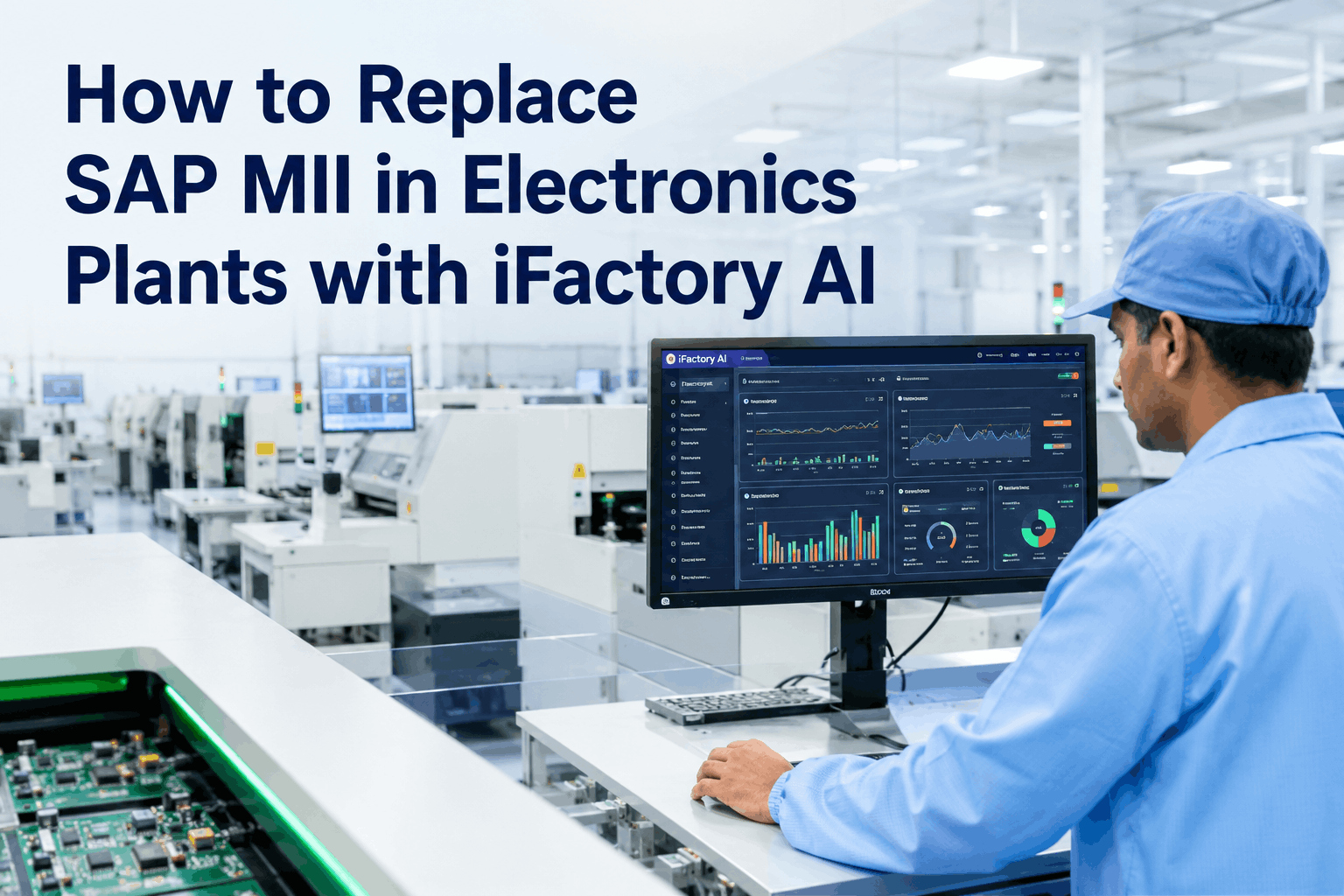
For electronics manufacturing executives — EMS leaders, plant general managers, VPs of operations and quality — the strategic problem with SAP MII / xMII isn't a feature gap, it's a visibility gap. The platform was architected to report what already happened, which means executive decisions about yield improvement, capacity allocation, quality investment, and customer commitments are made on lagging data that's hours or days stale by the time it reaches a dashboard. In electronics manufacturing, where first-pass yield drives margin, where DPMO determines customer scorecards, and where SMT line utilization governs whether you can take the next program, decisions made on stale data cost real money. The AI-Native Manufacturing Revolution changes the executive's relationship to the plant fundamentally. Industrial GenAI Copilots give executives the ability to ask strategic questions in natural language — "which lines are limiting our yield this quarter?", "where is quality cost concentrated across our sites?", "can we commit to the new program with current capacity?" — and receive synthesized, current answers drawing across every plant, line, and system in seconds. iFactory AI delivers this on a pre-configured NVIDIA appliance running on-premise inside the plant, replacing SAP MII, SAP xMII, and SAP DMC with an AI-native platform purpose-built for electronics operations, deployed in 12 weeks. This page is the electronics executive's guide to the AI-Native Manufacturing Revolution, what Industrial GenAI Copilots deliver at the strategic level, and how the migration from SAP MII pays back.
How to Replace SAP MII in Electronics Plants with iFactory AI
The electronics executive's guide to the AI-Native Manufacturing Revolution — Industrial GenAI Copilots that answer strategic yield, quality, capacity, and cost questions across every line and site in seconds. The top SAP MII alternative for electronics SPC Monitoring. Pre-configured NVIDIA AI server, pre-loaded software, 12-week delivery, no cloud lock-in.
The Executive Visibility Gap in Electronics Manufacturing
The strategic cost of SAP MII isn't visible on a feature comparison — it shows up in decisions made too late, on data too stale, across sites too siloed. For electronics executives, the visibility gap directly affects the metrics that determine plant profitability and competitive position. The comparison below shows what changes when the AI-Native Manufacturing Revolution replaces descriptive MII reporting with real-time GenAI Copilot intelligence.
The visibility gap executives live with
- Yield data hours or days stale by dashboard time
- Cross-site comparison requires manual consolidation
- Quality cost concentration invisible until month-end
- Capacity commitments made on lagging utilization data
- Root-cause of yield loss takes days to surface
- Strategic questions require analyst report cycles
- No predictive view — only what already happened
- Customer scorecard risk discovered after the fact
Strategic clarity in real-time
- Live yield across every line and site, current to the minute
- Cross-site benchmarking automatic and instant
- Quality cost concentration surfaced continuously
- Capacity commitments backed by real-time utilization
- Yield loss root-cause pre-computed in minutes
- Strategic questions answered by Copilot in seconds
- Predictive view — yield and quality risk 4–24 hr ahead
- Customer scorecard risk flagged before it materializes
For an electronics executive, the most consequential shift is from reactive to anticipatory. SAP MII can tell you last week's first-pass yield by line; the AI-Native platform tells you which lines are trending toward yield loss in the next shift and why — turning yield management from a monthly review exercise into a continuous strategic capability. Across a multi-site EMS operation, this difference compounds into measurable margin and competitive advantage.
Want a strategic visibility assessment for your electronics operation? Schedule the AI Manufacturing Transformation Workshop — iFactory's electronics team will map your current SAP MII visibility gaps to strategic cost and project the AI-native alternative. Sessions available this week.
Industrial GenAI Copilots for Electronics Executives — Four Strategic Types
For executives, the Industrial GenAI Copilot operates at the strategic level rather than the line level — synthesizing across plants, lines, programs, and time periods to answer the questions that drive plant-level and portfolio-level decisions. The four most strategically impactful copilots for electronics manufacturing leadership are shown below with representative executive query snippets.
Plant Performance Copilot
Yield Intelligence Copilot
Quality Strategy Copilot
Cost Optimization Copilot
Each copilot draws across the entire operational data estate — every line, every site, SPC and AOI data, MES and ERP context, and historical performance — synthesizing answers that would otherwise require analyst report cycles. Responses cite the underlying data and recommend strategic actions. For executives, this collapses the time between strategic question and informed answer from days to seconds, fundamentally changing the cadence of plant management.
Want to see Industrial GenAI Copilots answering strategic questions for your electronics operation? Schedule the AI Manufacturing Transformation Workshop — sessions include live demonstration of executive copilots on representative electronics scenarios. Sessions available this week.
Multi-Site Electronics Intelligence — The Portfolio View
How Copilots unify intelligence across sites and lines
For multi-site EMS and electronics OEM operations, the strategic value multiplies — the Copilot synthesizes across the entire manufacturing footprint, surfacing cross-site patterns, benchmarking opportunities, and portfolio-level optimization that no single-site dashboard can reveal. The architecture below shows how a single executive query reaches across the entire electronics manufacturing portfolio.
Three Migration Paths from SAP MII for Electronics
Stay on MII / xMII
Extended maintenance, descriptive reporting continues. No GenAI Copilots, no predictive intelligence. Executive visibility gap unchanged.
SAP DMC (Cloud-Only)
Cloud migration with descriptive dashboards. Latency-bound for real-time intelligence. WAN-dependent. Cloud lock-in concern compounds.
iFactory AI On-Prem
Industrial GenAI Copilots. Real-time cross-site intelligence. Predictive SPC. IPC-aligned. No cloud lock-in. 12-week delivery.
Six Electronics Operations Where AI-Native SPC + Copilots Pay Back Fastest
SMT Solder Paste (SPI)
Predictive SPC on solder paste inspection data catches volume drift before it drives reflow defects. Adaptive limits per board and stencil.
AOI & Inspection
AI Vision augments AOI to reduce false calls and catch genuine defects. Copilot correlates AOI findings to upstream process drift.
Reflow Soldering
Multivariate SPC across reflow zones. Adaptive limits per board thermal mass. Predictive warning on profile drift before defects emerge.
Pick-and-Place
Predictive nozzle health and feeder monitoring. Placement accuracy SPC per component type. Reduces downtime and misplacement defects.
PCB Fabrication
Multivariate SPC across fab process steps. Adaptive limits per board class. Copilot links yield loss to specific fab parameters.
Final Test & Box Build
Test yield SPC, failure pattern analysis. Copilot correlates test failures to upstream process signatures. Reduces test escapes.
Want application-specific projections for your electronics operation? Send your electronics segment, line configurations, and yield baselines to iFactory support and the electronics team will return a customised projection with 12-month roadmap — typically within 3 business days, no obligation.
IPC Standards, ISO & Traceability — Built In
Pre-built workflows for electronics manufacturing frameworks
- IPC-A-610 — Acceptability of Electronic Assemblies
- IPC-A-600 — Acceptability of Printed Boards
- IPC-9850 — SMT placement equipment characterization
- ISO 9001 — quality management system
- IATF 16949 — automotive electronics supply
- J-STD-001 — soldering requirements
- Component traceability — forward and backward
- DPMO & first-pass yield reporting — automated
The platform captures IPC acceptability data, DPMO metrics, first-pass yield, and full component traceability continuously. For executives serving automotive, aerospace, or medical electronics customers, the compliance evidence and traceability chain are assembled automatically — turning customer audit prep from a multi-week scramble into a real-time capability.
Two Real Electronics Executive Outcomes
EMS provider with 4 sites, 28 SMT lines, and cross-site yield variability
A mid-tier EMS contract manufacturer operating 4 sites across 28 SMT lines serving consumer, industrial, and automotive electronics customers. Executives lacked real-time cross-site visibility — yield comparisons required manual consolidation, and yield loss root-cause took days. SAP MII reported site-level data but couldn't synthesize portfolio intelligence or predict yield risk. Customer scorecards occasionally slipped before leadership could intervene.
Electronics OEM producing high-reliability products with strict quality cost pressure
An electronics OEM producing high-reliability products for industrial and medical customers across 12 SMT lines at a single large site. Quality cost (scrap, rework, test escapes) ran high relative to industry benchmark, and executives lacked the predictive view to address it proactively. SAP xMII captured the data but quality cost concentration only became clear at month-end review — too late to intervene.
Neither scenario matches your operation? Send your electronics segment, site footprint, and current SAP MII state to iFactory support and the electronics team will return a customised migration analysis with 12-month roadmap — typically within 3 business days, no obligation.
iFactory's Electronics Deployment — On-Premise or Cloud
Same AI-native platform on either deployment model. Same Industrial GenAI Copilots, predictive SPC, AI Vision, adaptive limits. For electronics operations, on-prem is recommended for latency at SMT line speed, data sovereignty (customer program IP), and operational independence — with cloud available for multi-site executives wanting central governance.
iFactory On-Premise Appliance Recommended for electronics plants · no cloud lock-in
- Pre-configured NVIDIA AI server — racked, software-loaded, ready to plug in.
- <50ms edge inference — keeps up with high-speed SMT lines.
- Customer program IP stays in plant — no cloud exposure.
- Works during WAN outages — Copilots and SPC continue.
iFactory Cloud For multi-site EMS executives with central governance
- Fully managed — no rack, no facility requirements.
- Same AI capabilities — GenAI Copilots, predictive SPC.
- Cross-site portfolio intelligence across all plants.
- Fastest deployment — first site live in 2–4 weeks.
The AI-Native Manufacturing Revolution closes the executive visibility gap.
Industrial GenAI Copilots that answer strategic yield, quality, capacity, and cost questions across every electronics line and site in seconds — running on a pre-configured NVIDIA appliance inside your plant. First-pass yield up 8–15%, cost of quality down 40–65%, customer scorecards protected proactively. The top SAP MII alternative for electronics. The AI Manufacturing Transformation Workshop sizes the migration concretely.
FAQ: Electronics AI Manufacturing & SAP MII Migration
How do Industrial GenAI Copilots integrate with our existing electronics systems?
iFactory integrates natively with major electronics manufacturing systems — SPI and AOI platforms (Koh Young, CyberOptics, Omron, Saki), SMT line equipment (ASM, Fuji, Yamaha, Panasonic), MES platforms, and SAP MII / xMII / ERP for context. The Copilots draw intelligence from these existing systems rather than replacing them. The deployment team configures specific integrations during the 12-week installation. Book a demo to map integration to your specific line equipment.
What is the difference between iFactory's on-premise and cloud deployment?
On-premise runs the full AI stack on a pre-configured NVIDIA appliance inside your plant — sub-50ms inference for real-time SPC, customer program IP stays in the plant, and Copilots continue working during WAN outages. Cloud is fully managed with no hardware, ideal for multi-site executives wanting central portfolio governance. Both deliver the same Industrial GenAI Copilots, predictive SPC, and AI Vision. For electronics, on-prem is typically recommended for latency and data sovereignty; many multi-site operations run a hybrid.
How does the Yield Intelligence Copilot quantify financial impact?
The Copilot links yield loss events to their root-cause process signatures, then quantifies the financial impact using your product cost, volume, and scrap/rework rates. When it reports "62% of yield loss concentrates in solder defects with estimated annualized impact of $3.1M", that figure is computed from your actual cost data, not a generic estimate. This lets executives prioritize improvement investments by financial return rather than by gut feel.
How quickly do executives see ROI after migration?
Most electronics operations see measurable first-pass yield improvement within the first quarter after deployment, with full ROI typically achieved within 9–15 months depending on baseline. The fastest returns come from predictive SPC on solder paste (SPI) and reflow, where yield improvements of 4–9% materialize quickly. The Industrial GenAI Copilots add strategic value immediately by collapsing decision latency from days to seconds. The Workshop provides a sized ROI projection for your specific operation.
Do I have to buy NVIDIA servers separately?
No. iFactory's on-premise appliance ships fully loaded — pre-configured NVIDIA AI server, software pre-installed, network gear, cabling, edge devices for line-side inference, and integration adapters for major SMT/SPI/AOI platforms. You provide rack space, line power, Ethernet, and integration points. The deployment team handles all installation and configuration. For cloud, no hardware investment at all.
Can we deploy at one site or line first before portfolio-wide?
Yes — and it's the recommended approach for multi-site operations. Start with the site where yield loss or quality cost is highest. Validate the predictive SPC performance and Copilot intelligence. Then expand site-by-site, with Portfolio Intelligence orchestration unifying cross-site visibility as each site comes online. A typical 4-site EMS operation completes full portfolio deployment in 5–8 months with executive cross-site intelligence active progressively.
What does the AI Manufacturing Transformation Workshop cover?
The half-day workshop covers — current-state SAP MII assessment with focus on executive visibility gaps, Industrial GenAI Copilot demonstration on representative electronics scenarios, three-path migration comparison with cost/timeline projections, predictive SPC walkthrough for SMT/PCB, IPC standards alignment, deployment roadmap, and ROI projection on yield and cost of quality. Outcome is a concrete migration plan. Suitable for executives, plant leadership, quality, IT, and finance representatives.
Stop managing electronics plants on lagging data. Start managing them in real-time.
The AI-Native Manufacturing Revolution gives electronics executives strategic intelligence across every line and site in seconds — Industrial GenAI Copilots, predictive SPC, real-time cross-site visibility, running on a pre-configured NVIDIA appliance inside your plant. The top SAP MII alternative for electronics. Pre-loaded software, 12-week delivery, no cloud lock-in. The Workshop is the fastest way to size the migration for your specific operation — sessions available this week.