
A mechanical seal rarely fails without warning. It weeps first: a film at the gland, then a drop, then a steady drip. The weekly check exists to catch it at the weeping stage. In the ready Centrifugal pump weekly check in iFactory Inspection the seal is one item with a clear pass line: dry, or under one drop a minute. This page describes how the item is checked, what a failure triggers and how the record helps you see a seal getting worse. In our test round it was the item that failed on P-101. Run the seal check in your workspace once your company is set up.
Inspection · Mechanical seal
Mechanical seal leakage rate: the weekly pump seal check
Shine a torch on the gland and count the drops. A clear count is more useful than a general impression and is easier to repeat from week to week.

What passes and what fails
Shine a torch on the seal gland and on the drain underneath it. A film of liquid, or a trail running down the housing, can show a leak that a quick glance would miss.
Passes
Dry
Under 1 drop a minute
Fails
Fails
Fails
Catch the weep before the drip
When the seal item fails, it raises its own work order, so the leak is not left to the memory of whoever saw it.
What a failure sets in motion
The seal item is High priority, which means that a failed item raises a work order due in 24 hours. A seal that has started to drip rarely gets better by itself.
The seal item in our test round
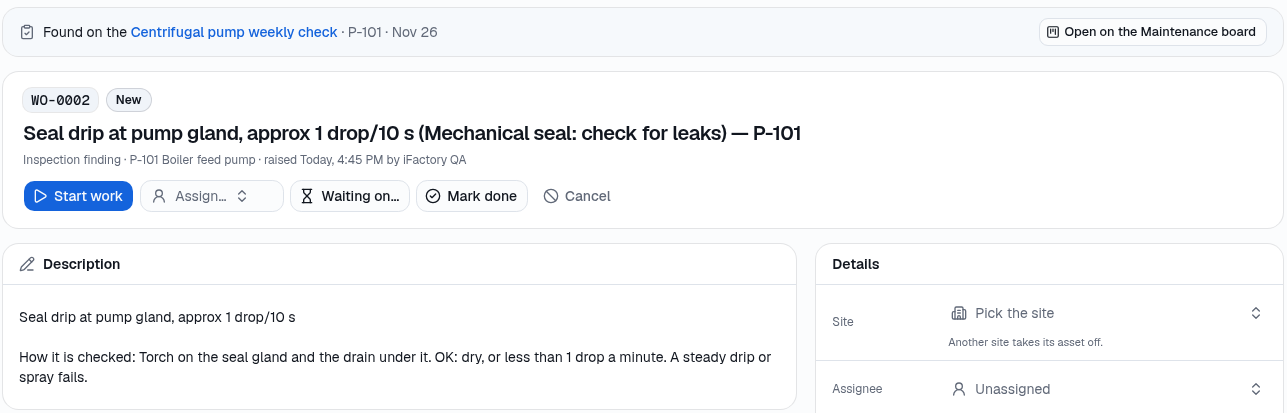
On 26 Nov 2026 item 8, the mechanical seal on boiler feed pump P-101, was marked Failed with the note "Seal drip at pump gland, approx 1 drop/10 s". The round raised WO-0002 at High priority. This is test data in a QA account.
Note
The note says what was seen, such as the rate of dripping, where it was running and what the pump was handling.
Work order
In our test round the failed seal item became WO-0002, a High priority work order with the technician's note attached.
Test data
This was a test in our QA account and not a customer result, so the figures show how the app behaves and not how a real seal performed.
How the history helps
The log keeps every round, so you can look back at when the seal item last failed and how long the repair took.
Failed items column
The rounds CSV lists the failed items of each round, so a month of pump rounds can be searched for the seal item in a spreadsheet.
This shows the rounds in which the seal item failed, and a seal that fails again and again points to a problem with the installation, not just with the seal.
Findings
Each failure is its own finding
Each failure is listed with its work order and status, so you can see whether the repair was done and how long it took.
Passing rounds do not store a reading, so a weeping seal is not recorded until the item fails. If you want to track a slow weep, write the drop rate in the note on a round where you notice it.
What a seal leak looks like on a round
A mechanical seal does not fail suddenly most of the time. It starts with a weep at the gland, a dark ring on the baseplate or a damp drain pipe under the pump. The item asks the technician to put a torch on the seal gland and the drain beneath it, because a small leak is easier to see in a beam of light than in the middle of a bright plant.
The limit is plain: dry, or less than one drop a minute, passes. A steady drip or spray fails. Count the drops for a minute if you are unsure, and write the rate in the note, as in our test round: seal drip at pump gland, approx 1 drop/10 s.
From a drip to a repair
A failed seal item is High priority, so it raises a work order due in 24 hours. The work order carries the item, the note, the how it is checked text and the limit. In our test it was assigned, started and moved to Waiting on parts, with a comment that the gland packing kit was ordered.
The Waiting status asks what the work is waiting on: parts, a shutdown, another trade or other. A seal often cannot be changed until the pump can be stopped, so Waiting keeps the job visible and not lost.
Using the history to catch a seal early
Each round is saved, so a seal that was dry for three weeks and weeping on the fourth is visible in History. If the same pump keeps failing the item, the cause may not be the seal: check alignment, vibration and the coupling on the same round, since a misaligned shaft shortens seal life.
The app records the answer and the note. It does not measure the leak or schedule the replacement, which is a maintenance decision made by the people who know the pump.
Taking a good look
The check uses a torch on the seal gland and on the drain below it. Look at the gland for wet marks and at the drain for liquid. A seal that is dry, or loses less than one drop a minute, passes. A steady drip or a spray fails.
If there is any doubt, count the drops for a short time with a watch. Many technicians do this by eye, but a clear count is easier to defend when it is written in the note.
The item is High, so a failure raises a work order due in 24 hours. If the product being pumped is hazardous, mention it in the note so that the person who picks up the work order knows what to wear.
Frequently asked questions
What is the seal leakage limit on the ready pump checklist?
The ready Centrifugal pump weekly check in iFactory Inspection passes the mechanical seal if the gland is dry or leaking under one drop a minute. It is a High priority item. The technician shines a torch on the gland and the drain beneath it, and counts the drops if there is any leakage.
How is the seal leak checked?
With a torch on the seal gland and the drain under it, with the pump running. The technician looks for a film, a drop or a steady drip, and counts the drops over a short time if there is doubt. The result is answered OK, Failed or N/A, and a failure needs a note saying what was seen.
How urgent is a failed seal item?
It is High priority, so a failure raises a work order due in 24 hours. The technician should say in the note how fast it was dripping and what the pump was handling. If the product is hazardous, say so, so that whoever picks up the work order knows what protection to wear.
Is a photo needed for a seal leak?
No, a photo is optional, but it helps. A picture of the gland or of the drip trail shows the fitter what the leak looks like before they get to the pump. The browser shrinks the photo to under 1 MB before it is uploaded, and the photo and note both go into the work order.
What else is checked on the same round?
The bearing temperatures, which pass below 70 °C and within 10 °C of last week; vibration, which passes below 4.5 mm/s; noise at the casing; and the motor running current against the nameplate. A seal that is wearing often shows in the vibration or the bearing temperature, so the items together tell a fuller story.
Does the app record how fast the seal is dripping?
Not as a number. The app records OK, Failed or N/A and a note on failures, so a passing round does not store a reading and a weeping seal is not recorded until the item fails. Write the drop rate in the note on the round where you first notice it, so that the history shows how the leak developed.
Catch seal leaks on every pump
Add the weekly pump check and see each failure as a work order.
- 1 drop a minute limit
- High priority work order
- Note and optional photo
14-day free trial · no card needed