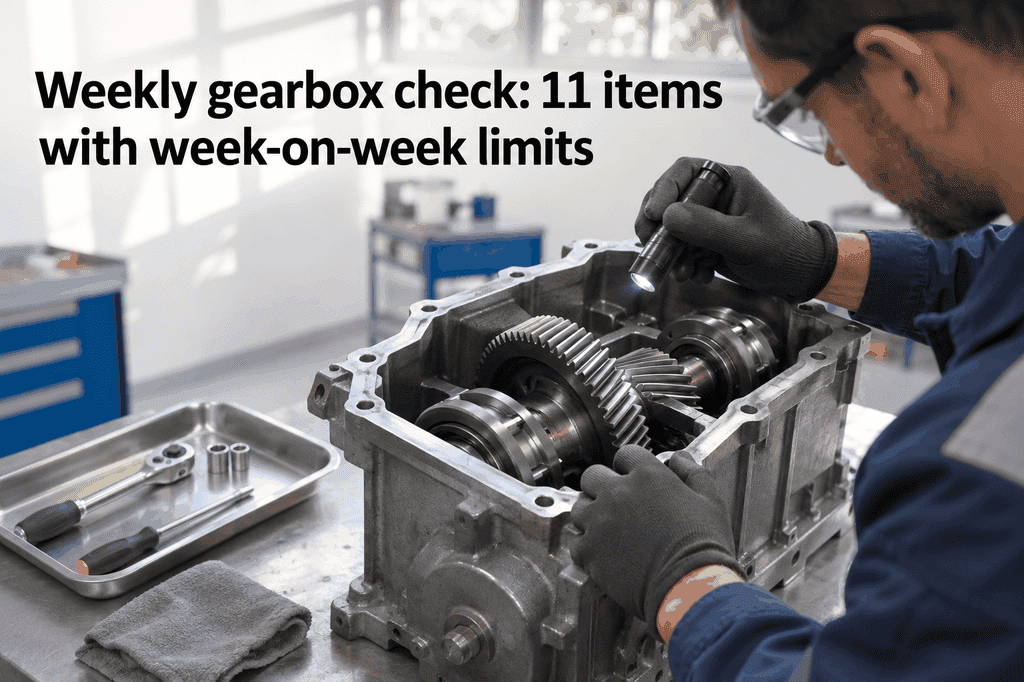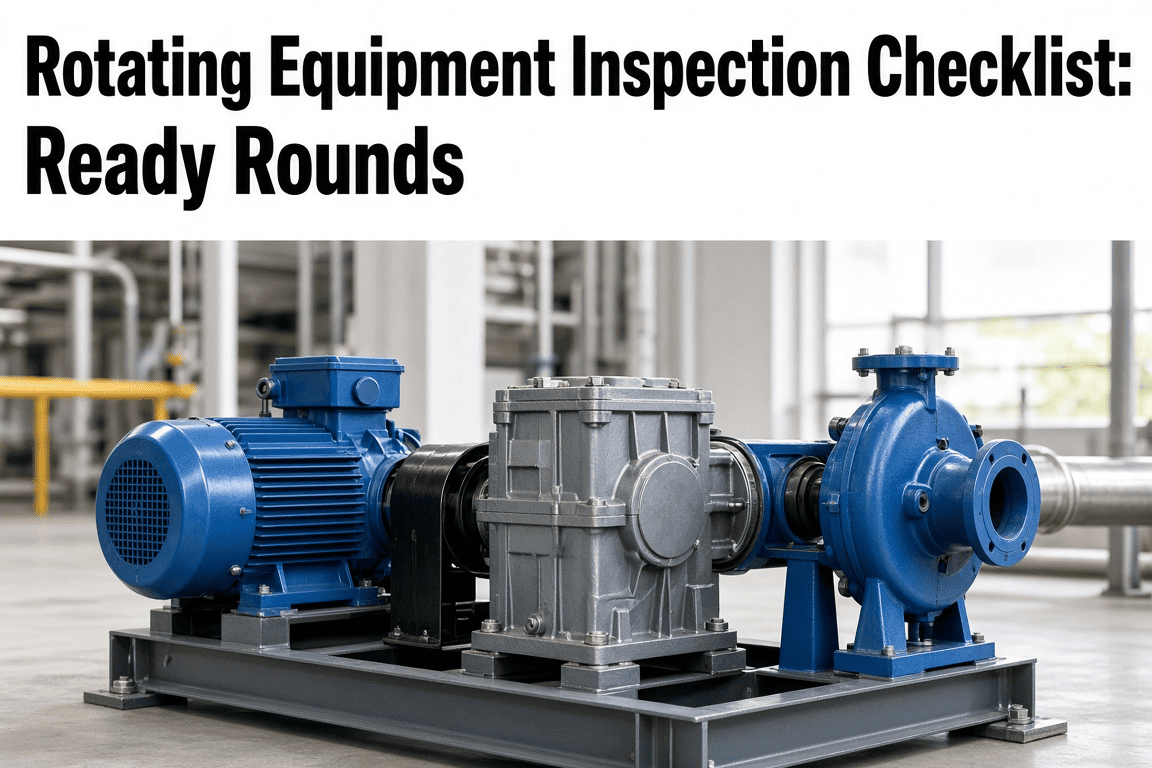
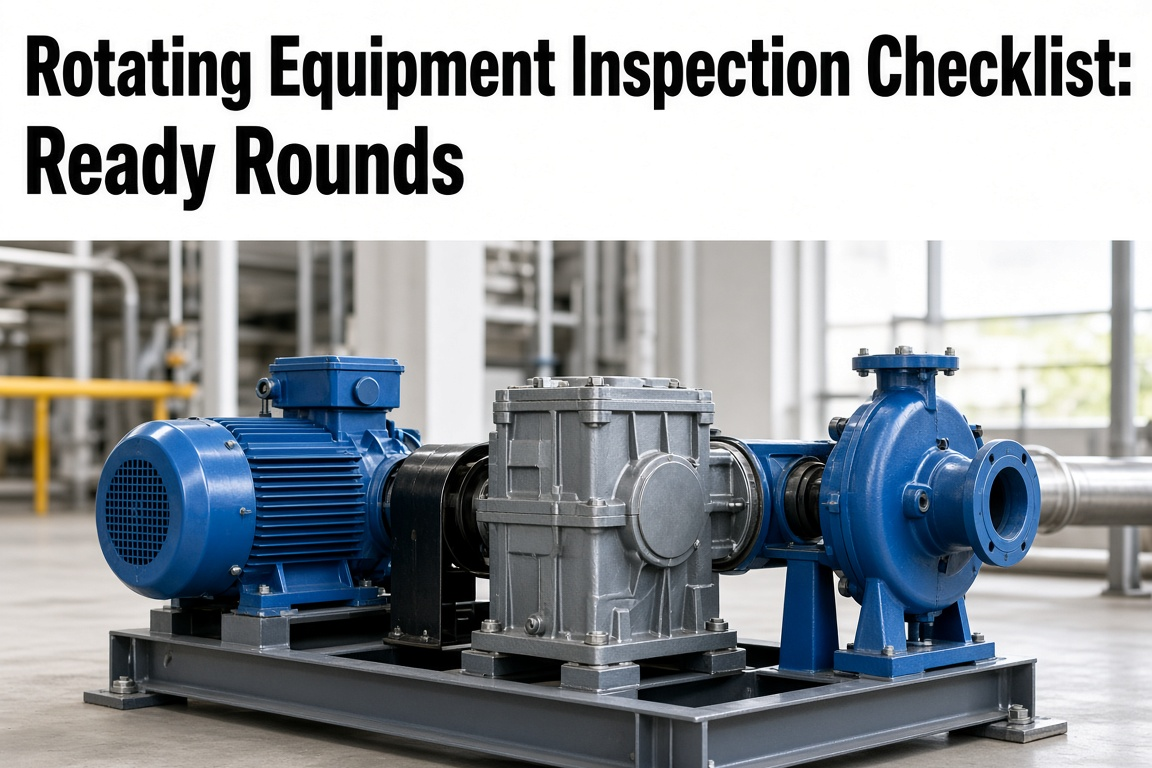
Rotating equipment has a family resemblance. A pump, a motor, a gearbox, a compressor and a cooling tower fan all turn, so they all have guards, bearings, lubrication, couplings or belts, and a way of telling you when something is wrong. The ready checklists in iFactory Inspection for these machines follow the same pattern, which is why one habit covers all of them. This page lays that pattern out and lists the five ready checks, with a note on what to do for a machine that is not on the list. Browse the ready checks in your workspace once your company is set up.
Inspection · Rotating equipment
Rotating equipment inspection checklist: ready rounds
The same pattern is shared by the pump, motor, gearbox, compressor and cooling tower checks, so a technician who has learnt one can pick up the others quickly.
The shared pattern
These are the things that are common to all five checks, from the guard to the oil, and each has a limit written in.
- Guards firstGuards come first on every round. They should be fitted and secure before anything else is done, because they protect the technician during the rest of the check.Safety items open every one of the five checks, and the most dangerous steps are flagged so they are not skipped.
- Lockout steps flaggedBolts, couplings, belts and blades are checked with the machine locked out, because the guard has to come off to reach them.The lockout flag on an item is a reminder that the machine needs isolating. Your own lockout procedure is what makes it safe.
- TemperatureBearing temperature is read with an IR gun on the housing, with a limit in °C and, on most items, a comparison with last week or with the other end.Most temperature items carry both a limit and a trend, because a bearing that is rising is as important as one that is hot.
- VibrationVibration is read with a pen on each bearing housing, with a limit stated in the item.The limits are written in mm/s and shown in your organisation's units, and they differ by machine, for example 4.5 mm/s for a pump and 7 mm/s for a cooling tower fan.
- NoiseNoise is checked by ear or with a stethoscope, listening for the sound that is different from a normal run.A passing machine has a steady sound with no knocking, rubbing or grinding, and any change from last week is worth a note.
- LubricationOil is checked for both level and condition on every one of the machines that has a sump or a bearing oiler.The oil is checked at the sight glass, the dipstick or with a small sample in a clear jar, depending on the machine.
One pattern for machines that turn
Because the habits are the same across all five checks, the training for each new machine is short.
The five ready checks
Here are the rotating machines in the library, with how many items each check has and how often it is done.
Ready check or your own
There are three ways to start: use a ready checklist, edit one to fit your machine, or let iFactory AI draft one from a description.
Run as it is
Pick the ready check
Edit your copy if needed
Not on the list
Have iFactory AI draft one
Check every limit
The ready checks in the app
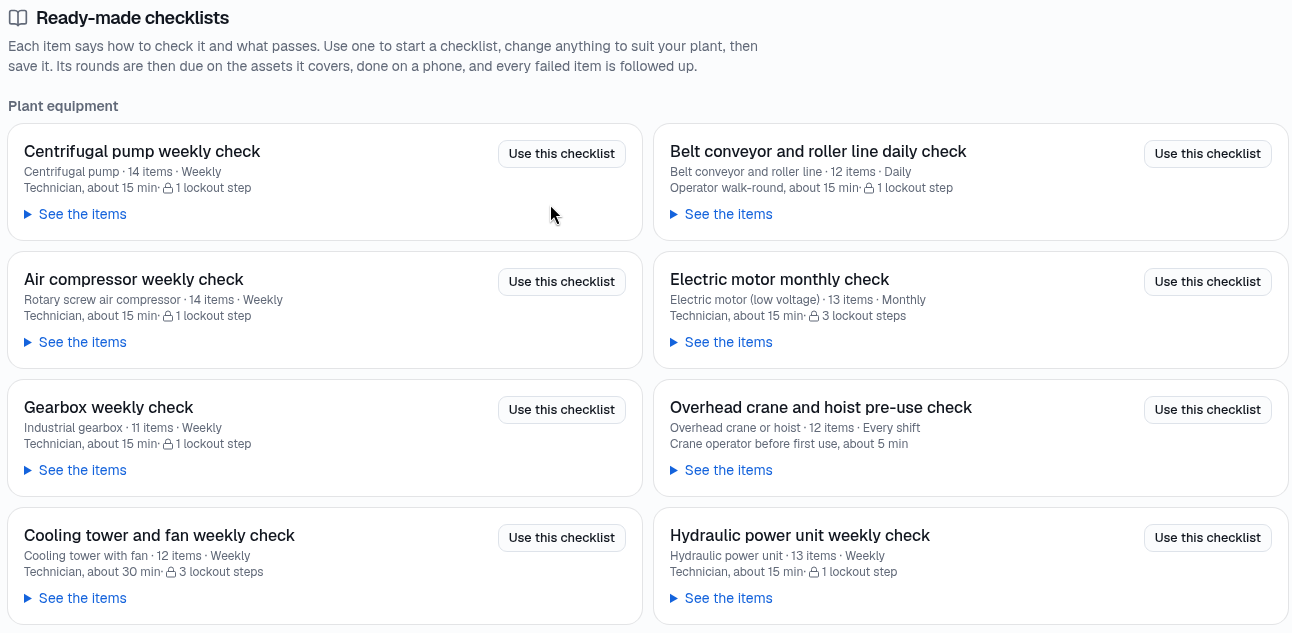
The library lists the plant equipment checks, including the rotating machines, and each opens as a new checklist that you can edit.
Before the first round
A few basic cautions apply to all five checks, because the limits are general and the app cannot make a machine safe.
OEM manual
Use the maker's manual for the machine, and check every limit against it before the first round.
Lockout
Follow your own lockout procedure, because the flag is only a reminder.
Edit freely
Change the items to fit the machine you actually have, for example if the coupling or the drive is a different type.
What rotating equipment has in common
Pumps, motors, gearboxes, compressors and cooling tower fans all turn, and the things that go wrong with them are related: bearings that run hot, vibration that creeps up, couplings that wear, oil that gets contaminated and guards that are left off. The ready checklists reflect this, which is why the same kinds of items show up in each.
That helps the person doing the rounds. Once a technician knows how to read a bearing temperature and a vibration pen on a pump, they can do the same on a motor or a gearbox, and the only things that change are the limits.
Same item, different limit
Bearing temperature is checked on pumps, motors and gearboxes, but not at the same figure: below 70 °C on a pump bearing, and below 80 °C on a motor bearing or gearbox case. Vibration is below 4.5 mm/s on a pump and a gearbox, below 2.8 mm/s on a motor up to 15 kW and below 7 mm/s on a cooling tower fan.
Writing a single rule for all rotating equipment would give wrong answers on some of them. Using a separate item for each machine, with its own limit, avoids it. If your machine has its own figure in the manual, edit the item.
Rounding it up on one list
You can run several rotating-equipment checklists side by side and read them together. The overview shows the rounds due today for each asset, and History lists what was found. If a motor and the pump it drives both fail on vibration in the same week, the coupling between them is the obvious place to look.
The coupling is where the rotating checks overlap. It is on the pump check, the motor check and the gearbox check, and each one asks for it to be locked out and guarded.
Choosing the order of the round
When one technician covers several machines in a row, group the items by what needs to be done rather than going machine by machine. Do all the live checks first while everything is running: temperatures, vibration, noise and current. Then stop and lock out what needs it and do the coupling, guard and bolt items.
That order reduces the number of lockouts to one per machine, and it means the readings are taken at normal load. The round on the phone follows the checklist order, so keep the items in the order you want them done by editing the checklist.
The checklists are written so that live checks come early and locked-out checks are marked, which supports doing the running readings first and the locked-out items last.
Frequently asked questions
What is on a rotating equipment inspection checklist?
The ready checks for pumps, motors, gearboxes, compressors and cooling tower fans share a pattern: guards first, lockout for bolts, couplings, belts and blades, bearing temperature by IR gun, vibration by pen with a limit in mm/s, noise, and oil level and condition. Each item says how to check it and what passes.
Which ready checks cover rotating equipment?
Five in iFactory Inspection: the Centrifugal pump weekly check, the Electric motor monthly check, the Gearbox weekly check, the Air compressor weekly check and the Cooling tower and fan weekly check. Each opens as a new checklist that you can edit. The crane and conveyor checks are also in the library, but they follow a different pattern.
Do all rotating checks use the same limits?
No. The pattern is the same, but the figures differ by machine. A pump bearing passes below 70 °C and a motor bearing below 80 °C. A pump passes below 4.5 mm/s of vibration, while a cooling tower fan passes below 7 mm/s. The limits are general, so check them against each machine's own manual.
Where do couplings appear on these checks?
On the pump check, the motor check and the gearbox check. Each marks the coupling as a lockout step, because the guard has to come off to see and feel it. That makes it the natural place to combine the checks when two machines are on one drive, since one isolation can cover both.
What if my machine is not on the list?
Start with the closest ready checklist and edit it, write one by hand, or let iFactory AI draft one from a description of the machine and what goes wrong with it. A person reviews every item and limit against the maker's manual and saves the checklist.
Can I mix these checks on one asset?
Yes. A checklist chooses its own assets and its own frequency, so a motor and the pump it drives can have separate checklists, or you can build one checklist for the pair. Past rounds keep the version they used. Doing the coupling items on one lockout saves time, so many sites schedule the pump and motor rounds on the same day.
Cover your rotating equipment
Start from the ready checks and make them your own.
- Five ready checks
- Lockout flagged
- Work order on failure
14-day free trial · no card needed