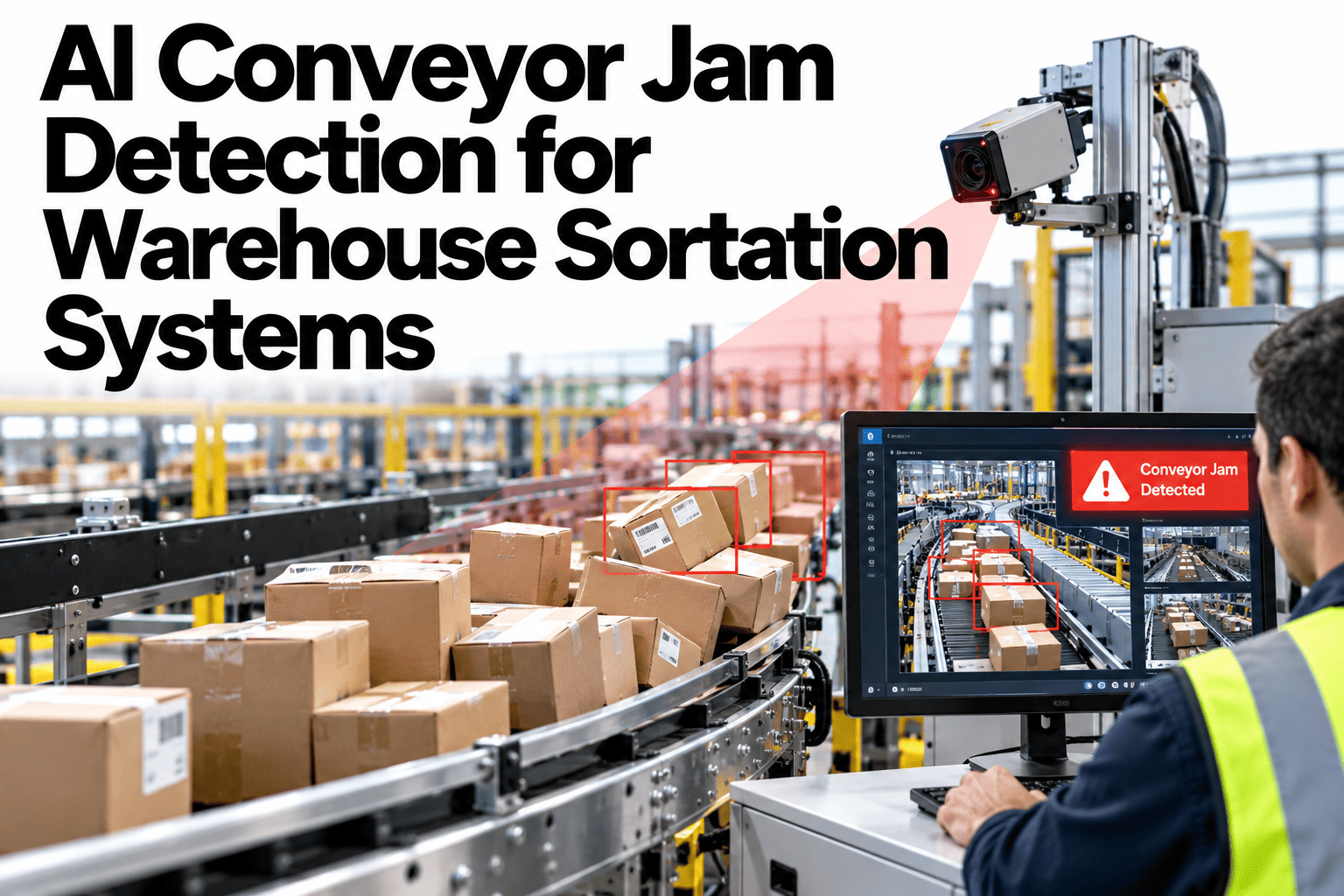
A sorter jam rarely announces itself. A chute backs up, parcels start piling against a guide rail, and by the time an operator notices on a walk-through, four minutes have passed and the whole wave behind it has backed up too. Conveyor jam detection watches the sortation system continuously, spotting a blockage within seconds instead of a walk-through cycle, and tracking which chute jams most often so the real fix gets found. Warehouse operations managers can see jam detection running against a live sortation feed on iFactory AI to judge the fit for their own system.
Four Minutes of Unnoticed Jam Backs Up the Whole Wave
iFactory AI watches the sortation system continuously, catching a blockage within seconds and tracking recurrence by chute.
What a Jam Costs Beyond the Blockage Itself
Parcels pile up at the jam point, stopping flow through that chute.
The main line slows or stops as sorted parcels have nowhere to go.
The whole wave's cutoff and outbound schedule absorbs the delay.
Someone has to walk to the jam, clear it, and restart the line.
Detection Methods Compared
| Method | Typical Detection Time | Main Weakness |
|---|---|---|
| Walk-through inspection | Minutes, only at the next round | No visibility between rounds |
| Fixed photo-eye sensor | Fast, but only at that one point | Misses jams elsewhere on the chute |
| Motor current spike | Fast for a full stall | Misses a partial blockage that doesn't stall the motor |
| Continuous vision monitoring | Seconds, across the chute | Needs camera coverage of the chute area |
Find Out Which Chutes Jam Most Often
Bring your current jam log to a 30-minute session and see which chute's pattern is costing the most recovery time.
Why the Same Chute Jams Again
Chute, time, and parcel characteristics at the moment of the jam.
Cluster jams by chute, shift and parcel type.
A worn guide rail, a tight merge angle, a divert timing issue.
Address the recurring cause, not just clear the jam again.
Manual Recovery vs Monitored Recovery
A Composite Scenario: The Chute Nobody Realized Was the Repeat Offender
Picture a sortation system where jams feel random, spread across a busy shift, each one cleared and forgotten. A closer look at a month of logged events shows one chute accounting for nearly a third of all jams, always on the same oversized parcel type.
Once the pattern is visible, a small mechanical adjustment to that chute's merge angle removes the recurring cause, instead of the team continuing to clear the same jam under a different timestamp every week.
Where iFactory AI Fits
Watches continuously
Monitors the sortation system in real time, not on a walk-through schedule.
Flags within seconds
Detects a blockage as it forms, before it backs up the wave.
Tracks recurrence by chute
Logs jams by location, time and parcel type to surface the real pattern.
Shortens recovery
Routes the alert to the nearest operator for a faster response.
Expert Review
A material handling systems perspective, reviewed for accuracy before publication: most sortation jam logs I review look chaotic until someone actually ranks them by chute. Almost every system I've seen has one or two chutes responsible for a disproportionate share of jams, and almost nobody notices until the data is laid out that way. Ranking your own jam history by chute usually takes less time than people expect and changes where the fix gets targeted.
Frequently Asked Questions
How much faster is vision-based jam detection than a walk-through?
Continuous monitoring can flag a jam within seconds of it forming, compared with the minutes it typically takes for an operator to reach that section on a normal walk-through cycle. The exact gap depends on your current walk-through frequency and chute layout. See how detection timing compares for your own sortation layout in a short session.
Can this tell the difference between a real jam and normal parcel buildup?
A system trained on your sortation system's normal flow patterns can generally distinguish a developing blockage from expected buildup at a merge point or during a busy period, though accuracy depends on how well it's calibrated to your specific chute geometry and parcel mix. Ask for a demonstration against your own parcel mix and chute layout.
What does it take to add camera coverage to our existing sortation system?
This depends on your chute layout, existing lighting conditions, and how many points need coverage, which varies significantly between facilities. A walkthrough of your current system is the most reliable way to scope what's needed. Explore a coverage assessment for your specific sortation layout.
How does recurrence tracking help beyond just clearing jams faster?
Faster clearing addresses the symptom each time it happens, while recurrence tracking identifies which chute, parcel type or shift pattern is driving jams repeatedly, pointing toward a mechanical or process fix that removes the cause rather than just responding to it faster. Try a review of what your own jam history would reveal once ranked.
How do we measure the return on jam detection for our sortation system?
Track average recovery time per jam, total jam-related downtime per shift, and wave timing slips before and after monitoring is in place. Because a single jam left unnoticed can cascade into a delayed wave affecting many outbound shipments, even a modest improvement in detection speed often shows a clear return. Join a session that estimates the return based on your own jam frequency.
Stop Finding Jams on the Next Walk-Through
iFactory AI watches your sortation system continuously and tracks which chute needs the real fix. Book a walkthrough on your own system.