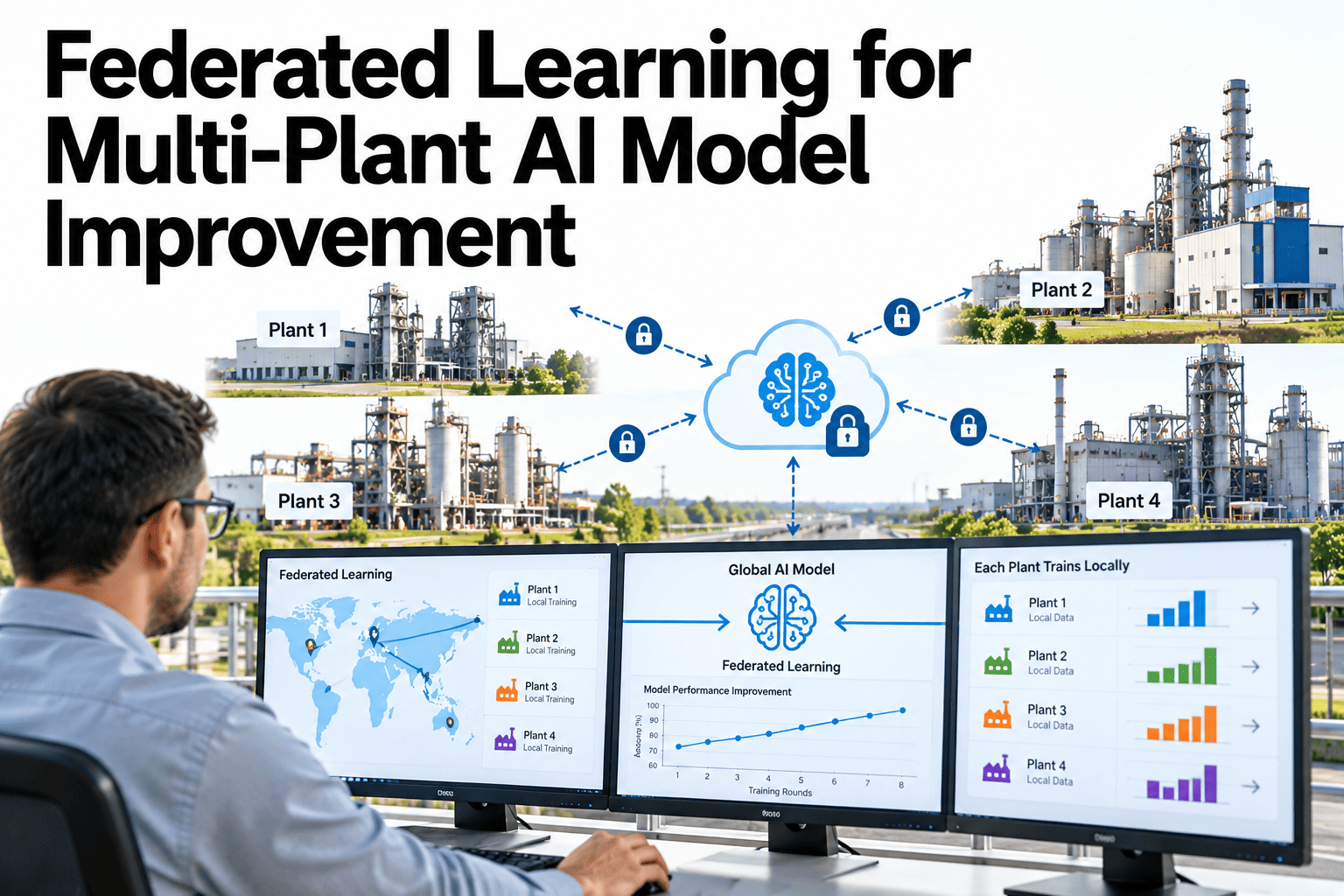
Every plant in a multi-site network has data it genuinely cannot share, whether for contractual, competitive or regulatory reasons, and problems that another plant in the same network already solved months ago. Federated learning is the approach built for exactly that tension: it lets models improve from the patterns learned at every site without moving the raw, sensitive data itself between them. Only model updates travel between plants, not the underlying production data. Enterprise architects can discuss a federated learning architecture for a specific multi-plant use case with the iFactory AI team before committing to a design.
Share What the Model Learned, Not the Data It Learned From
Federated learning improves a shared model using every plant's data, without that raw data ever leaving the site it came from.
Why Sharing Raw Data Isn't Always an Option
A customer or supplier agreement restricts how production data can move.
Regulatory requirements keep certain data within a specific jurisdiction.
Process parameters that reveal a plant's specific recipe or tuning.
Moving years of high-resolution production data is simply impractical.
How Federated Learning Works, in Plain Terms
Each plant trains the shared model on its own local data.
Only the model's learned parameters, not the raw data, are extracted.
Updates from all participating plants are combined into one improved model.
The improved shared model is sent back to every site.
Scope a Federated Approach for Your Plant Network
Bring your multi-plant data constraints to a 30-minute session and discuss what's architecturally realistic.
Centralized Data Pooling vs Federated Learning
Governance Questions Worth Settling Early
A Composite Scenario: The Defect Pattern One Plant Already Solved
Picture a plant network where Plant A's vision model has become highly accurate at catching a specific weld defect after years of local tuning, while Plant C, running similar equipment, still struggles with the same defect type and can't access Plant A's production data due to a customer confidentiality agreement.
A federated approach lets Plant C's shared model benefit from what Plant A's local training already learned about that defect pattern, without a single frame of Plant A's actual production footage ever leaving its site.
Where iFactory AI Fits
Coordinates the aggregation
Combines model updates from participating sites into one improved shared model.
Respects site boundaries
Keeps each plant's raw production data local throughout the process.
Supports local fine-tuning
Allows each site to adapt the shared model to its own specific conditions.
Governs the shared model
Validates performance across sites before distributing an update broadly.
Expert Review
An enterprise AI architecture perspective, reviewed for accuracy before publication: federated learning is a genuinely good fit for multi-plant manufacturing specifically because the constraint it solves, data that can't move but insight that should, is so common in this industry. It's not a universal answer, and for plants with no real data-sharing restriction, centralized training can still be simpler. Working through your network's actual constraints is the right starting point before committing to either architecture. Confirm current implementation capabilities directly, since this is an evolving area of the platform.
Frequently Asked Questions
Does federated learning guarantee that no sensitive information ever leaves a plant?
Federated learning's core design keeps raw data local and shares only model updates, which is a meaningfully stronger privacy posture than centralized data pooling. However, model updates themselves can in some cases leak information about the underlying data, so additional privacy-preserving techniques may be relevant depending on how sensitive your specific data is. See a discussion of privacy guarantees appropriate for your data sensitivity in a short session.
How many plants need to participate for federated learning to be worthwhile?
There's no strict minimum, but the value generally grows with more participating sites contributing diverse, relevant data, since a federated model with very few sites may not learn much more than each site could on its own. Whether it's worthwhile for your specific network depends on how similar the plants' equipment and processes are. Ask for an assessment of whether your plant count makes this worthwhile.
Can a plant keep its own fine-tuned version of the shared model?
This is a common pattern: a shared model benefits from cross-plant learning, while each site can further fine-tune its local copy to its own specific equipment, lighting or process conditions. The right balance between shared learning and local customization depends on how similar or different your plants actually are. Explore how local fine-tuning would work for your specific plants.
What infrastructure does a plant need to participate in federated learning?
Each site generally needs enough local compute to run model training, plus network connectivity reliable enough to periodically send and receive model updates, which are typically much smaller than raw production data. Specific requirements depend on model size and how frequently aggregation is planned. Try an infrastructure review for your specific plant sites.
How mature is federated learning for manufacturing specifically, versus other industries?
Federated learning techniques are well established in research and increasingly used in industries like healthcare and finance; manufacturing-specific implementations are newer and less standardized, so expect more custom architecture work than with a turnkey solution. Confirming current real-world deployment maturity for your specific use case is worth doing directly. Join a session on current manufacturing-specific maturity for your use case.
Let Every Plant Learn From the Others, Without Moving the Data
Discuss a federated learning architecture built around your plant network's real data constraints with the iFactory AI team.