Ask five people in a distribution center what "inventory accuracy" means and there's a good chance you'll get five different answers. One means the system count matches a physical cycle count. Another means a pick never comes up short. A third is really describing shrink rate, which is related but not the same thing. Without a shared definition, two managers can both report "99 percent accurate" while describing entirely different problems, or lack of one. Inventory control managers can see these metrics defined and benchmarked against iFactory AI's inventory data for their own operation.
"99% Accurate" Can Mean Five Different Things
iFactory AI defines inventory accuracy metrics consistently and benchmarks them, so "accurate" means the same thing across every report.
Five Metrics That Get Lumped Together
Does the system quantity match what's physically in the building, anywhere?
Is the item not just in the building, but in the specific bin the system says?
How often does a scheduled count match the system without adjustment?
What share of inventory value is lost to damage, theft or error over time?
How often does an order ship with the correct item and quantity?
Each metric points to a different failure mode and a different fix.
What Each Metric Actually Measures
| Metric | What It Catches | What It Misses |
|---|---|---|
| Record accuracy | Total system-vs-physical mismatch | Where in the building the mismatch is |
| Location accuracy | Items in the wrong bin | Items genuinely missing from the building |
| Cycle count accuracy | How stable counts are between audits | Errors that happen between count cycles |
| Shrink rate | Value lost over a period | The specific cause of each loss |
| Pick accuracy | Order fulfillment correctness | Whether the underlying record was ever right |
See Where Your Own Numbers Sit Against a Benchmark
Bring your current inventory reports to a 30-minute session and compare them against a consistent definition set.
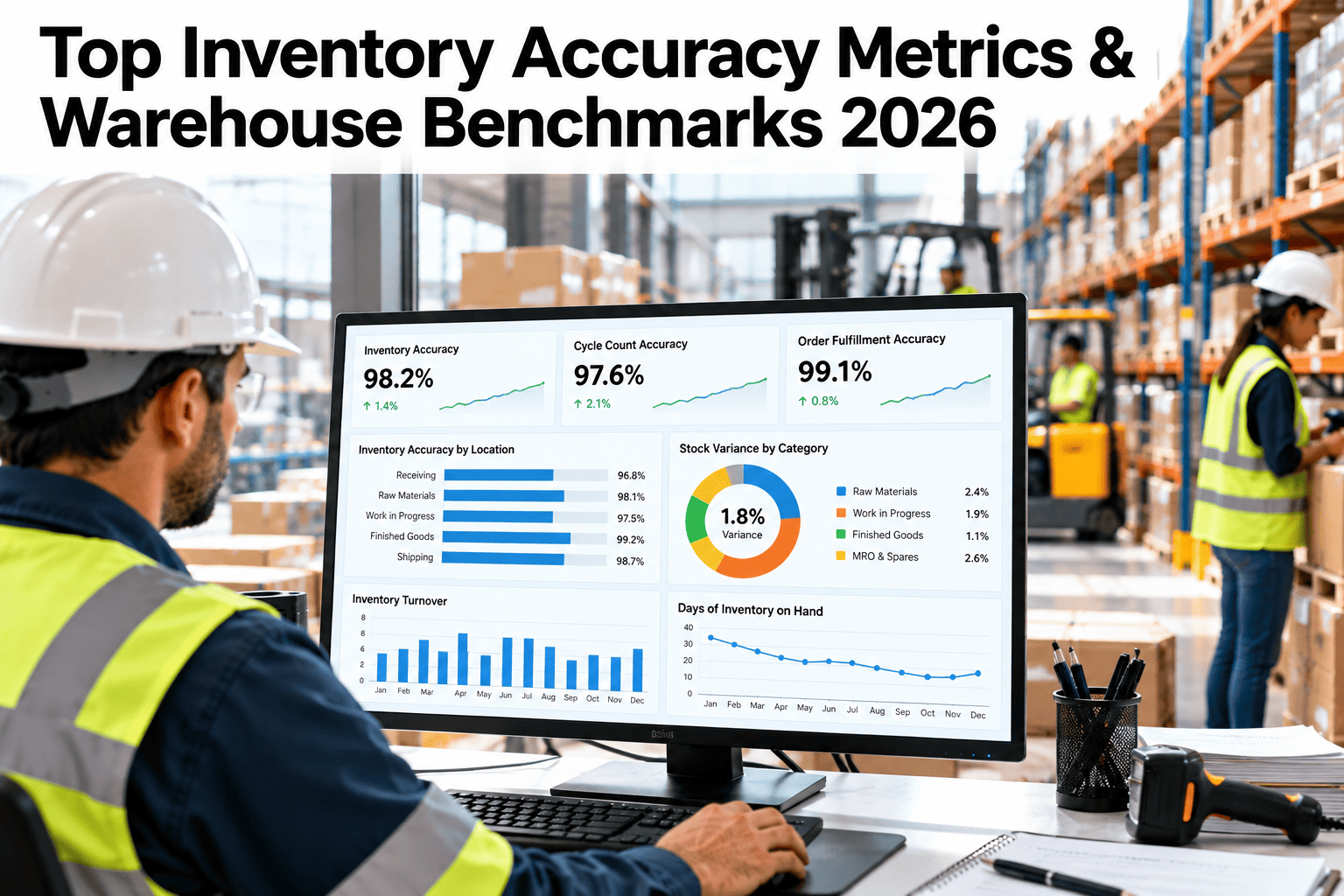
2026 Benchmark Ranges by Metric
Illustrative benchmark positioning. Actual target ranges vary by industry, SKU complexity and operation type, and should be set against your own operation's specifics rather than a single universal number.
A Composite Scenario: The Report That Said Everything Was Fine
Picture a monthly report showing 99.2 percent record accuracy, presented as evidence the warehouse is performing well. Pick errors keep happening anyway, and nobody can explain the gap.
A closer look shows location accuracy sitting far lower than record accuracy. Items are in the building, just not where the system says, which record accuracy alone never surfaces. Tracking the two metrics separately points the fix at putaway discipline instead of a mystery.
Where iFactory AI Fits
Defines metrics consistently
Applies one clear definition for each metric, used the same way every report.
Separates the signals
Tracks record, location, count and pick accuracy as distinct numbers.
Benchmarks against your own history
Compares current performance to your own trend, not just an industry average.
Points to the right fix
Shows which specific metric is driving a broader accuracy complaint.
Expert Review
A warehouse operations consultant's perspective, reviewed for accuracy before publication: the single most common inventory accuracy conversation I have starts with someone quoting a number that sounds good and a floor team that doesn't believe it. Almost always, the disconnect is that the quoted number measures something different from what the floor team is actually experiencing. Breaking your own reporting into these separate metrics usually resolves the disagreement in one sitting.
Frequently Asked Questions
What's the difference between record accuracy and location accuracy?
Record accuracy asks whether the total system quantity for an item matches what physically exists anywhere in the building. Location accuracy asks the more specific question of whether the item is in the exact bin or slot the system says it's in. An operation can have strong record accuracy and weak location accuracy at the same time, which is why tracking them separately matters. See how your own record and location accuracy compare in a short session.
What benchmark should we be targeting for cycle count accuracy?
Target ranges vary meaningfully by industry, SKU velocity, and how complex your storage configuration is, so a single universal number isn't a reliable target for every operation. Comparing your own trend over time, and against operations with a genuinely similar profile, tends to be more useful than chasing an industry-wide figure. Ask for a benchmark comparison suited to your specific operation type.
How is shrink rate different from a general inventory accuracy metric?
Shrink rate specifically measures value lost over a period, typically from damage, theft, administrative error or expiration, and it's usually expressed as a percentage of inventory value rather than a count match rate. It's related to accuracy but answers a financial question rather than a record-matching question. Explore how shrink rate is tracked separately from record accuracy in your reporting.
How often should cycle counts be performed to keep accuracy metrics meaningful?
Frequency depends on SKU velocity and risk, with high-velocity or high-value items often counted more frequently than slow-moving stock. A well-designed cycle count program targets count frequency by item risk rather than counting everything on the same fixed schedule. Try a review of a count frequency model suited to your SKU mix.
Can AI vision improve these metrics directly, or just measure them?
Both are relevant: measuring the metrics consistently is the first step to knowing what to fix, and vision-based putaway and pick verification can directly reduce the errors that drive location and pick accuracy down in the first place. The right combination depends on where your specific gaps show up once measured. Join a session on which approach fits your biggest measured gap.
Give "Accurate" One Meaning Across Every Report
iFactory AI tracks inventory accuracy metrics consistently so every team is looking at the same number. Book a walkthrough with your own data.